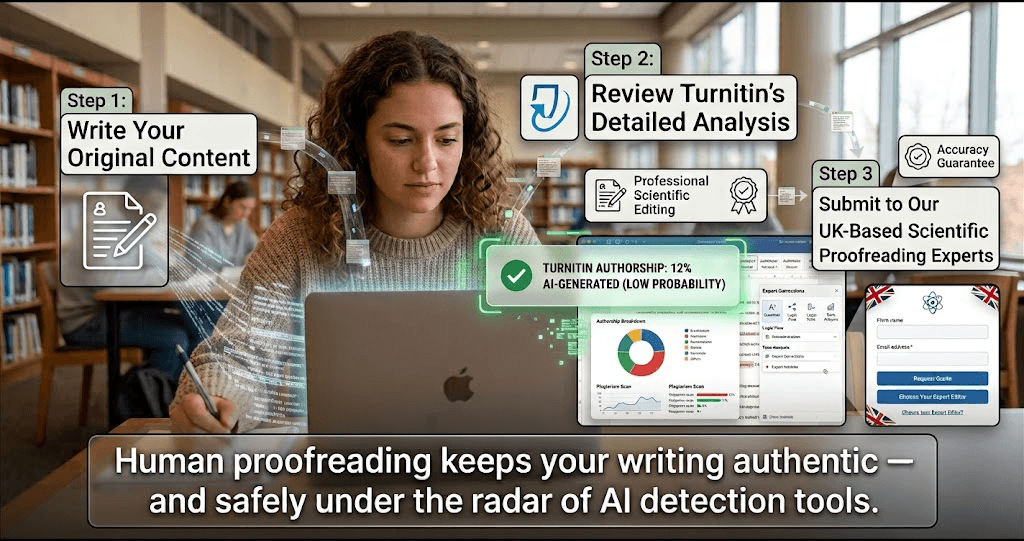
You submit the assignment. Then you sit there refreshing your inbox for the next hour, half-dreading what Turnitin might say about it. Sounds familiar? You’re definitely not the only one.
Since UK universities started bolting AI writing checks onto the usual plagiarism scan, there’s a new thing to stress over, getting your own work flagged for AI detection. It’s a strange spot to be in.
You wrote the essay. You even paid a proper proofreading service to tidy up the grammar and now here you are, wondering if a well-turned sentence is somehow going to get mistaken for a robot’s detection. It can definitely happen, for sure but it doesn’t have to.
This guide gets into how AI detection Turnitin systems actually works, why proofreading sometimes gets dragged into the mess, and what you can actually need to do about it.
Including why working with a proper academic proofreading service, like the team at Scientific Proofreading UK services, puts you in a much safer position than relying on your own last-minute edits or a free online tool.
We’re keeping this practical, too. No scaremongering, no wishy-washy reassurances, just a straight look at how this detection tech actually behaves, what UK universities really expect from you, and the concrete steps that keep your work being exactly what it’s supposed to be.
What Does “AI Detection & Turnitin” Actually Mean?
Turnitin’s AI writing indicator is a separate feature from the classic similarity report most students already know. The similarity checker does one thing, it compares your text against a massive database of published work, essays, and web pages, hunting for copied or unattributed content.
The AI writing check? Completely different job and it’s looking at how you write, sentence rhythm, how predictable your word choices are, whether the same structures keep popping up, and from that, it’s basically guessing how likely it is that a large language model wrote the thing, not a person sitting there typing it out.
This is exactly why “AI detection Turnitin” and how its AI writing detection technology is used too broadly. Students hear it and assume it’s one single “cheating detector.”
It’s just a probability score and sits right next to the similarity percentage, flagging up whatever sections happen to share statistical fingerprints with machine-generated text. Doesn’t prove anything by itself.
Understanding that distinction matters and a high similarity score usually means matched sources. A high AI score means the writing pattern looks synthetic. The Scientific Proofreading UK services actually makes your work bypass the AI detection and Turnitin check effectively, without your thoughts or contribution being altered.
They’re measuring completely different things, and conflating them is where a lot of student anxiety comes from.
Does Proofreading Trigger AI Detection?
This is probably the question we hear most from students who’ve just used a proofreading service and are now worried sick. Short answer: no, it shouldn’t. Genuine human proofreading and AI detection don’t really clash, though there’s some nuance worth getting into here.
Proper proofreading fixes your grammar, sorts out punctuation, tightens up sentence structure, and yeah, it sharpens the clarity too. What it doesn’t do is mess with your argument and it definitely won’t swap your voice out for something bland and generic-sounding.
A decent editor smooths over the clunky parts but leaves your actual voice alone and keeps those small inconsistencies in, the odd little quirks that make it obvious a real person sat down and wrote this.
Stuff that sounds like you, not like anyone else. Compare that to shoving a paragraph through an AI paraphraser instead.
Those tools flatten your sentence lengths out, lean way too hard on the same handful of transition words, and leave you with this weirdly even, almost too-tidy structure running through everything.
Does proofreading trigger AI detection? Not when it’s done by a human editor working carefully within your own words and voice. It becomes a risk only when “proofreading” is actually AI rewriting in disguise, which is exactly why choosing who edits your work matters so much more than people realise.
How Does Turnitin Detect AI Writing?
To make sense of AI detection and Turnitin results, it helps to know roughly what the software is actually measuring.
Turnitin’s model has been trained on huge volumes of both human-written and AI-generated academic text, learning the statistical differences between the two and in Natural Language processing (NLP).
Perplexity: How Predictable Your Word Choices Are
Perplexity is basically a measure of how predictable your word choices are, based on whatever came before them. AI text tends to play it too safe, the model almost always grabs the most statistically likely next word, which ends up sounding smooth, but also a bit generic.
Real writers don’t do that. People reach for less obvious words all the time, sometimes without even realising it, and that’s exactly what pushes perplexity higher in genuine student writing.
Burstiness: The Natural Rhythm of Human Writing
Burstiness refers to the natural variation in sentence length and complexity that real writers produce without ever thinking about it. One sentence’s short and punchy.
The next one stretches out, gets a bit more complex, maybe doubles back on itself. That’s just how people write when nobody’s forcing them into a pattern. AI text just doesn’t do that.
It stays weirdly consistent, same pace, same structure, all the way through, and once you know what you’re looking for, it’s a pretty easy pattern to spot.
Repetitive Structural Patterns
Language models just keep reaching for the same handful of phrase constructions and transition habits, the same go-to openers for a paragraph, the same way of linking one idea over to the next, and the same kind of line to wrap things up.
Do that enough times across a whole essay and you end up with a structural fingerprint building up underneath it all without you even noticing. Even when the words themselves keep shifting from one section to the next.
Segment-Level Scoring
Rather than judging an entire document as one single block, Turnitin scores sections individually.
This is why only part of an assignment sometimes gets flagged rather than the whole submission, a paragraph that was heavily AI-paraphrased can stand out clearly even inside an otherwise entirely human piece of writing.
At a Glance: What Turnitin’s AI Checker Looks For:
| Signal | What It Measures | Typical Human Pattern | Typical AI Pattern |
| Perplexity | Predictability of word choice | More varied, less predictable | Highly predictable, “safe” word choices |
| Burstiness | Variation in sentence length | Mix of short and long sentences | Uniform, evenly-paced sentences |
| Structural patterns | Repeated phrasing and transitions | Inconsistent, personal habits | Recognisable, repeated constructions |
| Segment scoring | Section-by-section analysis | Flags isolated to genuinely AI-written parts | Can expose heavily paraphrased sections within human work |
Turnitin Similarity Score Explained
As the two reports sit next to each other, students often blur similarity and AI scores together. It’s worth pulling them apart properly.
The Turnitin similarity score is explained simply, it’s a percentage showing how much of your text matches other sources already in Turnitin’s database, journal articles, websites, previously submitted student papers, and so on.
Turnitin Assessment=f(Similarity Score, AI Writing Score)
where:
- S = Similarity Score → percentage of text matching existing sources
- A = AI Writing Score → estimated percentage of text showing patterns associated with AI-generated writing
The key relationship is:
S and A are independent signals
A high similarity score isn’t automatically bad but properly quoted material, reference lists, and common phrases can bump the number up without any wrongdoing involved. What matters is how that matched text is used, cited and quoted correctly.
The AI writing score, by contrast, has nothing to do with matched sources. Basically, it’s a percentage, an estimate of how much of the document reads like it follows.
AI-generated patterns and the two scores don’t always line up, you can have a paper with barely any similarity matches that still picks up a fairly high AI score, or the other way round entirely.
Most universities treat these as two separate signals worth a closer look, rather than either one being treated as a final verdict on its own.
What About Human vs AI Writing Detection?
This is the most vital aspect to understand.
What Counts as Genuine Human Writing?
Basic grammar and spelling suggestions from writing tools are generally not flagged, because you’re still choosing every word yourself, the tool is correcting errors, not generating sentences for you.
This is the core distinction human vs AI writing detection is built around, whether the actual words and phrasing originated from you, or from a system generating them on your behalf.
When Writing Starts to Look Machine-Generated
Things get riskier with the generative rewriting features, the ones that write whole sentences or paragraphs for you instead of just nudging what you’ve already written. Accept enough of that AI-generated rewriting wholesale, and it’ll start to look machine-generated under detection analysis.
Which makes sense, because at that point it actually is machine-generated. The rule of thumb is worth sticking to, treat any tool as something that spots your errors, not something that writes your sentences.
Basic error-checking stays low risk. Whole paragraphs of AI rewriting? Means higher risk, no matter whose software produced it.
Can Proofreading Count as Plagiarism?
This question sits right alongside AI detection Turnitin worries, and it deserves a straight answer. No, legitimate proofreading isn’t plagiarism.
UK universities are generally pretty clear on that distinction, too. Most institutions are fine with proofreading that just fixes the language-level stuff, spelling, grammar, punctuation, formatting, all that consistency work. Where it tips into a problem is when an editor starts rewriting content instead.
Adding in arguments that weren’t there before. Restructuring how you actually reasoned through something, or rewording sections so heavily that the final piece just isn’t yours anymore.
Can proofreading count as plagiarism? Only if it stops being proofreading and starts being ghostwriting.
This is precisely why reputable services keep track of changes and comments rather than silently rewriting whole sections, it keeps the process transparent and defensible if a supervisor ever asks questions.
AI Content Checker UK Universities Rely On, and What the Policies Say?
Every AI content checker UK universities have adopted works slightly differently, but the underlying institutional stance has become fairly consistent across the sector.
AI tools aren’t banned outright in most cases, but undisclosed AI-generated submissions are treated as an academic integrity breach.
Broadly, UK university AI policy students should be aware of tends to include:
- A requirement to declare any use of AI tools during the writing or research paper editing process.
- Permission for AI use in limited, disclosed ways, such as brainstorming or checking grammar , while banning wholesale AI-generated submissions.
- A clear line between “using tools to check your writing” and “using tools to produce your writing.”
- Undisclosed AI use tends to trigger the same kind of escalating misconduct procedures as traditional plagiarism.
Policies aren’t identical everywhere, though, they shift from one institution to the next, and sometimes even between departments in the same university.
How to Avoid AI Flagging at University: Strategies That Actually Work
Write Your First Draft Yourself
Every paragraph should start as your own words before any editing enters the picture. This isn’t just good practice, it’s the thing everything else depends on.
Draft from scratch and your writing just naturally ends up with that sentence variation, those small inconsistencies, the personal rhythm that makes text feel like an actual person wrote it.
AI detectors are, more or less, trained to notice when that stuff is missing. Protecting it from the very first draft? Probably the single most useful habit you can build.
Use Human Editors, Not AI Paraphrasers
Once your draft exists, who touches it next matters enormously. Hand your work to an actual person instead of running it through an AI rewriter, and here’s the difference: your writing gets fixed, not swapped out for something else entirely.
A human editor will clean up your grammar, sharpen the clarity, but your style stays yours. AI paraphrases don’t work that way.
They tend to iron sentence structure out into this overly even, predictable rhythm, and that’s exactly the kind of pattern detection software is built to catch.
Keep Tracked Changes Visible
Always ask for a version of your document that shows exactly what was edited, rather than a silently “cleaned up” copy.
Tracked changes create a transparent record of the editing process, which words were altered, and why. This way you get to know about the ways to improve your writing through better editing.
If a supervisor or academic integrity panel ever has questions about your submission, this record is genuine, useful evidence that a person refined your language rather than generated it.
Vary Sentence Length Naturally
Mixing short, punchy sentences with longer, more complex ones isn’t just good style, it directly works against how AI detection tools operate. These systems look for what’s sometimes called a “burstiness gap”: the natural unevenness real writers produce without even thinking about it.
Uniform, evenly-paced sentences throughout a document is one of the clearest patterns associated with machine-generated text, so natural variation is one of your strongest defences.
Cite Properly and Consistently
Referencing every source correctly, using your required citation style, keeps your similarity score accurate and easy to explain.
Consistent and proper citation reinforces the overall impression of careful, deliberate academic editing services work, helping distinguish polished scholarly writing from rushed, pattern-heavy text that may raise concerns about AI-generated content.
Avoid AI Paraphrasing Tools Entirely
Skipping “AI humaniser” tools and paraphrasing software altogether, including even ones that promise to bypass detection. In reality, these tools tend to leave behind statistical traces of their own. Using them often adds more risk than it takes away.
Read Your Work Aloud Before Submitting
While reading your work do you find it to be sounding like your work or it sounds like a page? The answer is the second one if, then you need to definitely fix it before submitting the final version.
Personal phrasing that appears to be slightly imperfect and reading it aloud actually identifies errors or robotic inputs.
Disclose Any AI Assistance Used
Used AI somewhere along the way, brainstorming, outlining, maybe just sorting out your grammar?
Follow your university’s declaration rules, ask for, and don’t overthink it. Even if a false flag pops up later, having already disclosed it works in your favour. It hands over the markers the full picture from day one instead of making them guess at what happened.
None of this is complicated. You need to put it all together and you’ve got a submission that looks, reads, and scores like genuine human academic work and reduces the one that has AI in academic writing.
What to Do If You Get a Turnitin False Positive AI Flag?
A Turnitin false positive happens more often than universities like to have it, especially to students whose natural writing style is already clean, formal, maybe a bit repetitive.
A few things that actually help:
- Ask for the specific report showing which sections got flagged.
- Pull together evidence of your process, drafts, notes, version history, research logs, whatever you’ve got.
- If you use a proofreader, request their tracked-changes document. It shows the edit history in black and white.
- Explain your natural writing habits calmly. Factually. Not defensively.
- Ask if there’s room for a follow-up chat, or a viva-style conversation, to clear things up properly.
Universities run review processes for exactly this reason because they know the tech isn’t flawless. Stay calm, stay organised, bring your evidence. That’s genuinely the most effective response there is.
AI Writing Detection Accuracy: Why No Tool Is Perfect?
Yes, AI writing detection accuracy has come a long way over the past couple of years. However, the independent testing keeps showing the same thing, over and over again. The table below states this clearly:
| Limitation | Human Writing Flagged as AI | AI Writing Missed by Detectors | What Actually Helps |
| Reason | Very clean, formal, or consistent natural style | Lightly edited by a person after generation | Clean drafting process |
| Who’s affected | Non-native English writers, naturally formal writers | Anyone who edits AI output before submitting | Proper citation |
| Reliability | Not treated as definitive proof by universities | Not treated as definitive proof by universities | Natural voice |
| Safeguard | Human review, tracked changes, drafts as evidence | One signal among several, not a final verdict | Documented edits |
The Three-Question Test for Using AI Safely
Plenty of students use AI tools somewhere in their process, for brainstorming, structuring an outline, or checking that an argument makes sense, and that’s not automatically a problem. The safe use of AI tools for essays generally comes down to three questions:
- Is the final written text actually yours, word for word?
- Have you disclosed the tool used according to your university’s policy?
- Could you explain, without hesitating, exactly how you used it if someone asked you directly?
Answer ,yes, to all three, and you’re almost certainly fine. But if one of those answers feels misleading, that’s your cue, either stop using the tool that way, or go check with your tutor before you submit, not after.

Why Choose Scientific Proofreading for Your Academic Work?
Who do you actually trust to touch your work before it goes anywhere near submission? If you’re trying to dodge both the plagiarism worries and the AI flagging worries at once, the answer isn’t complicated. Find a real person, someone who is an expert and genuinely knows your subject, and let them proofread the writing you actually did.
Human Editors Who Understand Academic Writing
Scientific Proofreading assigns manuscript formatting and essays to editors matched by subject area and document type, rather than running everything through a generic template.
That subject-matched approach means your natural academic voice and technical vocabulary stay intact, which is exactly the quality that keeps writing and reading as authentically human.
Editing, Not Rewriting
The service works by correcting grammar, clarity, structure, and terminology consistency without hijacking your argument or your findings.
The process focuses on tightening what’s already there rather than generating new text, there’s no risk of your work drifting into the kind of AI-style paraphrasing pattern that raises AI detection Turnitin concerns in the first place.
Tracked Changes You Can Actually Show Someone
If a supervisor or integrity panel ever does start asking questions about your submission, that documentation actually counts for something. It’s solid proof that a real person, not a machine, was the one refining your language.
Confidentiality as Standard
Your manuscript, dissertation and thesis writing, or essay stays confidential the whole way through, nobody’s sharing your unpublished work with third parties. That matters a lot if you’re a research student already anxious about originality or data protection.
Experience Across the Fields That Matter to You
With editors covering life sciences, medical sciences, engineering, social sciences, and dozens of other subject areas, the team understands that a chemistry paper and an economics essay simply don’t read the same way.
Where This Kind of Proofreading Support Gets Used?
| Document Type | Common Concern | How Careful Human Proofreading Helps |
| Undergraduate essays | Grammar slips, unclear arguments | Tightens language while preserving natural sentence variation |
| Dissertations & theses | Long-form consistency, terminology drift | Keeps tone and structure human across tens of thousands of words |
| Journal articles | Reviewer clarity, technical phrasing | Refines academic register without flattening your voice |
| PhD chapters | Repetition, flow between sections | Improves readability while retaining your argument and authorship |
| Research proposals | Persuasive clarity for reviewers | Sharpens phrasing without introducing generic, templated wording |
| Conference papers | Tight word counts, precise language | Trims unnecessary words while keeping your specific meaning |
| Non-native English submissions | Natural phrasing, idiomatic accuracy | Smooths sentence flow without erasing personal writing style |
Quick Tips and Corrections Before You Submit
- Read the whole document aloud once before submitting.
- Vary your sentence openings; starting every sentence the same way is a pattern detector’s notice.
- Keep a folder of drafts and notes as proof of your writing process.
- Skip the “AI humaniser” tools altogether, running a full essay through one, hoping it slips past undetected is a gamble that usually backfires.
- Ask for tracked changes. A quietly rewritten “clean” copy tells you nothing about what actually changed.
- Leave your technical terms alone, don’t let an editor trade them out for vague, generic synonyms.
- Unsure if a tool’s crossed the line? Ask your tutor first. Not after you’ve already submitted.
- Go with a proofreading service that’s straight about how it works, uses actual human editors, and takes confidentiality seriously.
Frequently Asked Questions
No, genuine human proofreading preserves your natural voice and shouldn’t trigger AI flags.
It analyses sentence predictability and structural patterns typical of machine-generated text.
No, not when it corrects language only and leaves your ideas and argument untouched.
A genuine human-written section incorrectly flagged as AI-generated.
No, similarity checks matched sources and the AI score checks writing patterns.
No, detection tools give probability estimates, not proof.
Yes, always follow your institution’s specific AI policy on disclosure.
Human editors correct language without introducing detectable AI writing patterns.
Staying Safe from AI Detection Turnitin Flags
Worrying about AI flags shouldn’t stop you getting real help with your writing, the two things aren’t even in conflict. A genuine proofreading service exists to make your words clearer not to replace them, and that one distinction is basically what keeps human academic writing recognisable as well.
Write your own arguments. Keep your own voice documenting your process as you go. Pick editors who work on tracked changes instead of quietly rewriting things behind the scenes. Do that, and there’s really not much left for a detection tool to catch you on. That is the main purpose Scientific Proofreading UK services is offering.
If you’d rather not roll the dice on some free online checker, or a rushed AI paraphraser at midnight before a deadline, going with an established proofreading service gets you both things at once. The polish, and the paper trail to back it up.