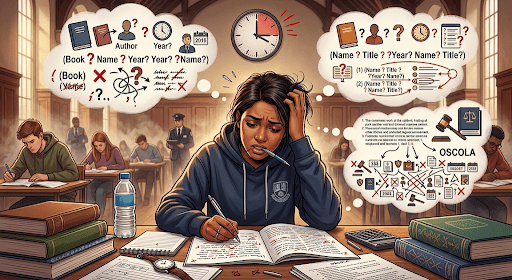
Your brain moves fast, but your hands do not always keep up and your eyes also. Exams are stressful and this is when grammar mistakes UK students make often creep in.
This guide looks at the most common grammar errors students make during timed essays and exams.
It also gives a clear referencing style comparison UK students can trust, covering Harvard vs APA vs OSCOLA. .
You will know writing accuracy during exams, and how to protect it even when the clock is ticking, by the end, punctuation mistakes in exams, and how to avoid them, and follow simple referencing rules for essays.
Why Exam Pressure Causes More Writing Mistakes
How your brain works stress changes that. Under pressure,grammar and spelling come second. Your mind focuses on ideas first.
This is why exam stress writing errors happen even to strong students. It is not about intelligence. It is about time and pressure.
Understanding how exam stress affects writing accuracy is the first step. The second step is learning the exact errors to look for.
Time pressure also narrows focus. Students concentrate hard on finishing their answer, and small details like commas fall out of view.
Common Grammar Mistakes UK Students Make Under Exam Pressure
Exam pressure can make students write too fast and make simple grammar mistakes. Here are some common ones:
1. Subject-Verb Errors
The subject and verb must match.
Wrong: The study show.
Right: The study shows.
2. Tense Mix-Ups
past and present tense, Do not switch between them without a reason. present for facts and Use the past for completed research and .
3. Run-On Sentences
It is hard to read when the sentences are very long. To separate different ideas use full stops.
4. Sentence Fragments
A fragment is not a complete sentence. “Because the sample was small.” needs more information to complete the idea.
5. Apostrophe Errors
“it’s” is “it is” and “its” means belonging to it, remember that. Words like “students”, which are plural, do not need an apostrophe.
6. Comma Splices
Use a full stop, semicolon, or joining word and do not just join two full sentences with only a comma.
7. Wrong Word Choices
Words like “affect/effect” and “their/there” are easy to mix up. Give them a quick check.
8. Long Paragraphs
Keep one main idea per paragraph. This makes your essay easier to read.
9. Missing Articles
Small words like “a,” “an,” and “the” do not forget them. They help sentences sound complete.
10. Capitalisation
for names, subjects, and theories, for proper nounsas well, use capital letters correctly. Keep your style consistent.
Wrong vs Right: Quick Grammar Fixes You Can Learn in Seconds
Seeing a mistake next to its fix helps it stick in your memory. Here are common slips written both ways
| Wrong | Right | Quick Fix |
| Its important to reference sources. | It’s important to reference sources. | “It’s” = “it is” |
| The researchers found results. | The researchers found results. | No apostrophe for plurals |
| Because the sample was small. | The sample was small. | Make it a complete sentence |
| The study shows clear patterns. | The study shows clear patterns. | “Study” = singular |
| Effect of stress was studied. | The effect of stress was studied. | Add “the” |
| The results are clear, this proves it. | The results are clear. This proves it. | Use a full stop |
Why Markers Notice Grammar and Referencing Mistakes First
Markers read hundreds of scripts. Clean grammar and correct citations make your work easier to follow from the very first line.
Many UK marking rubrics score ‘clarity’ and ‘academic conventions’ as separate categories, alongside your actual argument.
This means two students with the same ideas can receive different grades, purely because of grammar and referencing accuracy.
Fixing grammar mistakes UK students repeat is not about perfection. It is about protecting marks you have already earned through good ideas.
Punctuation Mistakes in Exams: A Quick Checklist
Punctuation mistakes in exams are some of the fastest marks to lose, and the fastest to fix once you know what to check.
| Punctuation | Common Mistake | Quick Fix |
|---|---|---|
| Comma (,) | Missing after an opening phrase | Add a comma after “However,” or “In addition,” |
| Full stop (.) | Missing at the end | Check that every sentence ends properly. |
| Apostrophe (’) | Mixing up its/it’s | If “it is” fits, use “it’s.” |
| Semicolon (;) | Using it incorrectly | Use it to join two complete sentences. |
| Quotation marks (“ ”) | Missing around direct quotes | Put exact words from a source in quotation marks. |
| Colon (:) | Used after an incomplete sentence | Make sure the words before it form a full sentence. |
Harvard vs APA vs OSCOLA: What Is the Difference?
UK universities use several referencing systems. The three most common are Harvard, APA, and OSCOLA.
Each style has its own rules for in-text citations and reference lists. Mixing them up is one of the easiest ways to lose marks.
This referencing style comparison UK table shows the key differences at a glance.
| Feature | Harvard | APA | OSCOLA |
|---|---|---|---|
| Used mainly for | Business, social sciences, humanities | Psychology, education, sciences | Law and legal studies |
| In-text format | (Author, Year) | (Author, Year) | Footnotes, not in-text brackets |
| Page numbers | Added for direct quotes | Required for direct quotes | Given in the footnote itself |
| Reference list name | Reference list or bibliography | References | Bibliography, table of cases and legislation |
| Punctuation style | Full stops between elements | Commas and italics for titles | Minimal punctuation, no full stops after abbreviations |
| Best for citing | Books, journals, websites | Journal articles, research studies | Cases, statutes, legal journals |
Which Referencing Style Should You Use in the UK?
The honest answer is that it depends on your subject and your university handbook. There is no single correct style for every course.
Here is a simple guide for which referencing style to use UK courses typically expect.
| Subject Area | Common Style | Why |
|---|---|---|
| Law | OSCOLA | Built specifically for cases, statutes, and legal sources |
| Psychology | APA | Matches the format used in major psychology journals |
| Business and Management | Harvard | Widely accepted across UK business schools |
| Nursing and Medicine | APA or Harvard | Depends on the specific university’s handbook |
| History and Humanities | Harvard or footnote styles | Often set by the department, always check first |
| Education | APA | Aligns with published education research |
Harvard Referencing Common Mistakes
These Harvard referencing common mistakes are easy to make, especially when you are in a hurry.
- In an in-text citation, forgetting the publication year.
- Using “et al.” for two authors instead of three or more.
- Not putting the reference list in alphabetical order.
- For italics and quotation marks using different styles .
- Mentioning a source in the essay but leaving it out of the reference list.
- Using different date formats in the reference list.
APA Referencing Common Mistakes
APA referencing common mistakes are slightly different from Harvard, because APA has stricter formatting rules.
- Forgetting the ampersand (&) inside brackets, for example (Smith & Jones, 2023)
- Not italicising journal titles and volume numbers
- Missing the DOI or URL for online sources
- Using ‘and’ instead of ‘&’ inside parenthetical citations
- Incorrect capitalisation in article titles within the reference list
- Confusing the seventh edition rules with older APA editions
APA style is precise about small details. A missing ampersand or wrong capital letter can cost marks, even when the source itself is correct.
OSCOLA Referencing Guide: Rules for Law Students
OSCOLA is different from Harvard and APA. It uses footnotes instead of brackets in the main text.
This short OSCOLA referencing guide covers the basics every law student should know before an exam.
- Case names are italicised, but the year and citation are not
- Footnote numbers go after punctuation, not before it
- No full stops are used after abbreviations like ‘p’ for page
- Statutes are cited by their short title and year, without brackets around the year
- A pinpoint reference points to the exact paragraph or page inside a footnote
- The bibliography splits sources into cases, legislation, and secondary sources
How to Reference Under Time Pressure
Knowing how to reference under time pressure can help you avoid easy mistakes in an exam.
- Learn your basic in-text citation format before the exam.
- Remember the author’s surname and publication year.
- Add a page number for direct quotes.
- Throughout your work use the same citation style .
- Don’t guess missing details. Leave them and check later if you have time.
Grammar Checklist for Exams
A short grammar checklist for exams helps you catch mistakes fast during the last few minutes of medical writing.
| Check | What to Look For | Time Needed |
|---|---|---|
| Sentence endings | Every sentence ends with a full stop | 30 seconds |
| Verb tense | Tense stays consistent within each paragraph | 1 minute |
| Apostrophes | Its vs it’s, and correct plural forms | 30 seconds |
| Capital letters | Proper nouns and the start of every sentence | 30 seconds |
| Paragraph length | No single paragraph runs longer than a page | 30 seconds |
| Citations | Every in-text citation appears in the reference list | 1 minute |
This whole checklist takes under four minutes. It is one of the highest-value habits for writing accuracy during exams.
Building Writing Accuracy During Exams: Practical Habits
Improving writing accuracy during exams is a skill, and like any skill, it improves with practice before the exam day.
Before the Exam
Practice writing timed answers at home. Time pressure feels different when you have trained for it. Learn your referencing style so well that it becomes automatic. This frees up mental space for your arguments.
During the Exam
Plan your paragraphs before you start writing. A short plan prevents rambling sentences later. Write in short, clear sentences. Long sentences are more likely to break grammar rules under pressure.
In the Final Minutes
Always save time to reread your work. Even two minutes of checking catches many small slips. Read your conclusion first. Markers often remember the ending, so it deserves a careful final check.
Improving your everyday writing habits also helps here, covering habits that carry over well into exam conditions.
How Student Proofreading Services Can Help
This matters most for referencing, since referencing rules for essays can be strict, and small errors add up across a long piece of work. When you are searching for the best proofreading services UK has to offer, look for editors who understand Harvard, APA, and OSCOLA equally well.
Academic editing service checks grammar, structure, and referencing together, so nothing gets missed before submission. For longer projects, dissertation and thesis editing service applies the same close attention across every chapter and every citation.
Students preparing research papers can also benefit from research paper editing service, which checks referencing consistency alongside grammar and clarity.
Common Mistakes by Exam Type
Different exam formats bring different risks. Knowing what to expect helps you prepare the right way.
Open-Book Exams
Students often copy text directly from allowed materials without quotation marks. This can look like an accident, but it still counts as a referencing error.
Always pause to add quotation marks the moment you copy exact wording, not at the end when you may forget.
Closed-Book Exams
Without access to sources, students often guess dates or author names. A wrong guess is usually safer than leaving a citation out entirely.
Learn a small set of key names and dates for your topic in advance, so you are not guessing blind on the day.
Take-Home Papers
These allow more time, but referencing lists often get rushed at the very end. Save at least ten minutes purely for checking your reference list.
A rushed reference list is one of the easiest places to lose marks, since every entry can be checked in detail by a marker.
Common Myths About Grammar and Referencing Under Pressure
A few myths make students more anxious than they need to be. Clearing them up can lower exam stress on its own.
Myth: Perfect Grammar Matters More Than Ideas
This is false. Strong ideas still carry the most marks in most UK rubrics. Grammar affects clarity, not the core argument.
Myth: You Must Remember Every Reference Detail Exactly
Markers look for consistency and effort, not perfection. A close, consistent attempt is far better than leaving citations out.
Myth: OSCOLA Is Too Hard to Learn Quickly
OSCOLA has fewer core rules than people expect. Learning the footnote pattern for cases and statutes covers most exam situations.
Myth: Referencing Software Removes All Risk of Mistakes
Reference tools help, but they often get details wrong. Always check the output against your citation style guide UK universities provide.
A Simple Pre-Exam Referencing and Grammar Routine
A short routine, repeated before every exam, builds confidence and reduces last-minute panic over rules.
- Reread your course handbook’s referencing section the night before
- Write out your in-text citation format from memory, then check it
- Review your top five most-used sources and their correct details
- Practise one timed paragraph, then check it against the grammar checklist above
- Get a full night’s sleep, since tired brains make far more small mistakes
This routine takes under thirty minutes but can protect several marks across a single exam paper.
What to Look For in the Best Proofreading Services UK Has to Offer
Not every proofreading service understands UK university rules in the same depth. A few checks help you choose well.
| What to Check | Why It Matters |
|---|---|
| Experience with UK academic writing | UK spelling, tone, and structure differ from US or international styles |
| Knowledge of Harvard, APA, and OSCOLA | Your editor should match your exact required style, not just a general one |
| Clear turnaround times | Deadlines are strict, so timing matters as much as quality |
| Human editors, not only automated tools | Software misses context that a trained human eye catches easily |
| Confidentiality of your work | Your dissertation or research should stay fully private and secure |
A good editor treats grammar and referencing as one connected job, not two separate checks done in a rush.
Frequently Asked Questions
Which referencing style is most common in UK universities?
Harvard is widely used, especially in business, humanities, and social sciences.
Is OSCOLA only for law?
Yes. OSCOLA is mainly used for law and legal studies.
How can I avoid referencing mistakes?
Learn the basic rules, use the same format, and check your citations before submitting.
Can grammar mistakes lose marks?
Yes. Frequent grammar mistakes can affect your clarity and accuracy marks.
What is the difference between Harvard and APA?
Both use the author and year, but they have different formatting rules.
How much time should I spend checking grammar?
Try to save the last five minutes to check grammar, punctuation, and citations.
Can proofreading help before an exam?
Yes, proofreading can help with coursework and assignments, but not during a live exam.
What if I forget the referencing style?
Check your course handbook or module guide first. Don’t guess if you can check.
Are UK and US grammar rules different?
Some spelling and punctuation rules are different. Use UK English if your course requires it.
Why do I make more mistakes at the end of an exam?
You can get tired after writing for a long time. A quick final check can help catch these mistakes.
Finish Strong with Better Grammar and Referencing
Grammar and referencing mistakes are common under exam pressure, but they are not random. Most follow the same patterns every time.
Once you know the Harvard vs APA vs OSCOLA rules for your subject, and you build a quick checklist habit, your writing becomes far more accurate.
For coursework and dissertations, where you have more time to get things right, expert support is always available.
Reach out to the Scientific Proofreading team and let a professional editor help your work meet UK university standards, every single time.