
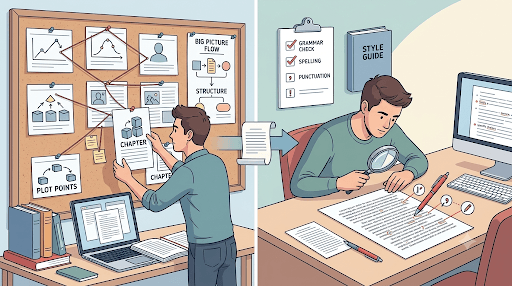
“Structural editing (also called developmental editing) focuses on the big picture of a manuscript plot, pacing, character arcs, chapter flow, and overall narrative logic. Copy editing focuses on the surface layer grammar, punctuation, spelling, consistency, and style. Both are essential stages in the manuscript editing process, and structural editing always comes first. Authors preparing a novel for publishing in the UK typically move through structural editing, then line editing, then copy editing, and finally proofreading before submission.”
Most authors know their manuscripts need editing before they reach a literary agent or a publisher. What many authors do not know is that the word ‘editing’ covers several very different processes, and choosing the wrong one at the wrong time can waste months of effort and money.
If you send your novel to a copy editor before the structure is solid, you end up polishing sentences that may need to be cut entirely. If you hire a structural editor when you only need light proofreading, you are paying for a service your manuscript does not yet require.
This guide breaks down the complete Manuscript Formatting process for authors, from structural editing all the way through to proofreading, so you can walk into each stage with confidence. Whether you are preparing a debut novel for submission in the UK, finishing a non-fiction book, or simply trying to understand what literary agents and publishers look for, this guide covers everything you need.
What Is Structural Editing? (And Why It Comes First)
Structural editing, also called developmental editing, substantive editing, or content editing, is the deepest and most transformative stage of the manuscript editing process. It examines whether your book works as a complete piece of writing.
At this stage, the editor is not concerned with whether you have used a semicolon correctly. The structural editor is asking far bigger questions:
- Does the opening hook the reader and introduce conflict quickly enough?
- Is the plot logical, consistent, and free of holes?
- Are the chapter and scene transitions smooth and purposeful?
- Does each scene move the story forward, or does it stall momentum?
- Are the characters fully developed, and are their motivations believable?
- Is the pacing consistent throughout, not too slow in the middle, not too rushed at the climax?
- Does the narrative arc build, develop, and resolve satisfyingly?
For non-fiction, the structural editor looks at the clarity of the central argument, the logical order of chapters and sections, whether the evidence supports the claims made, and whether the reader is guided through the material in a way that builds genuine understanding. These same principles are essential for developing a strong academic writing style, where clear structure and logical progression help readers engage with complex ideas.
Structural editing is sometimes the most emotionally challenging stage for authors because it may require rewriting entire chapters, changing the order of events, or removing characters and subplots that do not serve the story. However, this work is what separates a publishable manuscript from a good idea that never quite lands.
What is Copy Editing? (And Why It Is Not Just Proofreading)
Copy editing sits at a different stage in the editing pipeline. Once the structure is solid and the manuscript has been through line editing (see below), a copy editor refines the writing at a technical and stylistic level.
A good copy editor works across four primary areas, often described in the industry as the Four Cs:
- Correctness — Grammar, spelling, punctuation, and factual accuracy
- Consistency — Character names, timelines, formatting, and terminology used uniformly throughout
- Clarity — Sentences that are easy to follow and free of ambiguity
- Coherence — Paragraphs and sections that flow logically from one to the next
Copy editing does not involve restructuring chapters or rewriting the plot. A copy editor works within the manuscript as it stands, assuming the structure has already been approved. Their job is to make the manuscript clean, professional, and reader-ready to remove all the small distractions that pull a reader out of the story.
Copy editing is also distinct from proofreading. Proofreading is the very final stage, performed after typesetting or layout, and catches only the last residual errors. Copy editing is more thorough and is performed on the manuscript before the design stage begins.
Structural Editing vs Copy Editing — Side-by-Side Comparison
| Feature | Structural Editing | Copy Editing |
|---|---|---|
| Stage in process | First (big picture, before line editing) | Third (after line editing, before proofreading) |
| Focus area | Plot, pacing, structure, character arcs, chapter flow | Grammar, punctuation, spelling, consistency, clarity |
| Scope of changes | May involve rewriting, reordering, or removing sections | Works within the existing manuscript — no restructuring |
| What the editor delivers | Editorial report or detailed tracked changes with macro-level notes | Fully tracked manuscript with corrections and comments |
| When you need it | After your best self-edited draft, before line editing | After line editing, once structure and prose are settled |
| Works with | Plot holes, pacing issues, weak character development, unclear argument | Grammar errors, inconsistent names, unclear sentences, style slips |
| Also called | Developmental editing, substantive editing, and content editing | Copyediting sometimes overlaps with light line editing |
| Agent relevance | Directly, agents often reject manuscripts with structural flaws | Indirectly, agents notice poor grammar and inconsistency |
The Full Manuscript Editing Process — All Five Stages Explained
Most published books move through several distinct editing stages. Understanding each stage helps you work with editors more effectively, submit at the right time, and spend your editing budget wisely.
| Editing Stage | What It Covers |
|---|---|
| 1. Manuscript Assessment / Editorial Report | A high-level review of the entire manuscript. The editor reads and produces a written report covering overall structure, major strengths and weaknesses, and priorities for revision. No edits are made to the text itself. Ideal as a first step before committing to a full structural edit. |
| 2. Structural Editing (Developmental Editing) | A deep, big-picture edit covering plot, narrative arc, pacing, character arcs, chapter structure, and overall coherence. The most intensive stage. May result in significant rewriting, reordering, or cutting of material. |
| 3. Line Editing | A focused review of each sentence and paragraph for style, voice, rhythm, and flow. Sits between structural and copy editing. The line editor ensures the writing is engaging, each sentence earns its place, and the author’s voice is consistent. |
| 4. Copy Editing | A technical edit addressing grammar, punctuation, spelling, consistency, and clarity. Works within the established manuscript without restructuring. Ensures the manuscript meets professional publishing standards. |
| 5. Proofreading | The final check, performed after typesetting or layout. Catches any last typographical errors, formatting inconsistencies, and pagination issues. Not a substitute for copy editing. |
Not every manuscript requires all five stages. A debut novel with significant structural issues needs to start at stage one or two. A polished, well-structured draft from an experienced author may only need copy editing and proofreading before submission.
How to Fix Pacing Issues in a Book: What Structural Editors Look For
Pacing is one of the most frequently flagged issues in structural editing and one of the hardest for authors to identify on their own, simply because they are too close to the material. Here is what a structural editor looks for when assessing pacing:
Signs Your Manuscript Has Pacing Problems
- The inciting incident arrives too late typically, it should appear within the first 10 to 15 percent of the manuscript
- Chapters in the middle of the novel are noticeably longer or quieter, with no forward plot momentum
- Action-heavy climax scenes feel rushed, or the resolution arrives too quickly after the peak conflict
- Scenes include long stretches of dialogue or internal monologue that do not advance the plot
- The reader is given too much backstory or world-building before the central conflict is established
- Chapter endings do not create enough forward momentum or tension to keep the reader turning pages

Practical Fixes for Pacing Issues
- Compare chapter word counts across your manuscript, and dramatic variations often flag pacing imbalances
- Remove scenes where nothing changes for the protagonist by the end of the scene
- Shorten action and climax scenes by using shorter sentences and fewer descriptive passages
- Use scene breaks and chapter endings as deliberate pacing tools a well-placed cliffhanger pulls readers forward
- Cut or compress the backstory and move it deeper into the narrative, revealing it only as readers need it
- Read your manuscript aloud, and slow or unengaging sections usually become apparent as you read
A professional structural editor will identify all of these issues in a single editorial report, saving you months of circular self-revision.
Self-Editing Tips for Authors: How to Prepare Before Hiring an Editor
Professional editing services give you the most value when your manuscript is already at its best, self-edited state. Here are the most journal article editing strategies UK authors can apply before submitting to an editor or a literary agent:
For Structural Self-Editing
- Write a reverse outline: read your finished manuscript and summarise each chapter in one sentence. This reveals structure gaps, repeated beats, and missing transitions immediately.
- Check that every scene has a clear purpose, it should either move the plot forward or reveal something essential about a character.
- Ensure your protagonist is actively driving the story rather than reacting to events in every chapter.
- Ask beta readers specifically about pacing, character consistency, and whether the ending felt earned.
For Copy Editing Self-Editing
- Use the search function in your word processor to find overused words (very, just, really, that, suddenly) and reduce them.
- Check that character names, place names, and factual details are spelled consistently throughout.
- Read each chapter backwards one sentence at a time to catch grammar and spelling errors your brain normally skips.
- Verify that dialogue attribution is clear and consistent throughout the manuscript.
What Do Literary Agents Look For? Why Editing Matters for UK Submissions
Literary agents in the UK receive hundreds of submissions every week. The manuscripts that reach the top of a consideration pile share several qualities, and most of them relate directly to the quality of the academic editing the author has done before submission.
What UK Literary Agents Expect to See
- A completed, fully edited manuscript for fiction, not a work in progress
- A compelling opening that establishes voice, conflict, and character within the first few pages
- Consistent pacing that keeps the story moving from the first chapter to the last
- A polished, professional standard of grammar and presentation
- A clear, well-written synopsis that reflects how the full manuscript is structured
- A cover letter that demonstrates the author understands the genre and target market
Many UK literary agents explicitly note that structural problems, weak pacing, underdeveloped characters, and unclear plot arcs are among the most common reasons they pass on a manuscript they initially found interesting. Grammar alone will not save a poorly structured novel, equally, a well-structured manuscript with poor presentation reflects badly on an author’s professionalism.
Preparing a Novel for Publishing in the UK: The Complete Manuscript Checklist
Use this checklist before submitting your manuscript to a literary agent, publisher, or professional editor:
| Stage | Tasks to Complete |
|---|---|
| Structural Review | Confirm plot logic is consistent throughout. Identify and remove scenes that do not advance the plot or character. Verify pacing across all three acts. Check character arcs are fully developed and resolved. Ensure POV consistency throughout. |
| Line Editing | Ensure each paragraph earns its place. Check that dialogue is purposeful and not padding. Verify sentence rhythm and variety. Cut overwriting, filler phrases, and repetition. Ensure the author’s voice is consistent. |
| Copy Editing | Run a thorough grammar and spelling check. Verify all character names, dates, and facts are consistent. Check that punctuation style is consistent throughout. Ensure chapter and section headings follow a clear format. |
| Submission Formatting (UK) | Use Times New Roman 12pt or a similar clean serif font. Set line spacing to 1.5 or double. Number all pages. Ensure the first three chapters represent the very best of the manuscript. Prepare a synopsis of two pages maximum. Draft a professional covering letter. |
| Final Proofreading | Read from a printed version if possible. Read slowly and aloud for the final pass. Check for any formatting inconsistencies introduced during revision. Verify that the page count and word count are correct. |
Which Type of Editing Does Your Manuscript Need Right Now?
Authors often reach out to book editing services at very different stages of the writing process. Use the guide below to identify where your manuscript currently sits:
| Your Situation | Type of Editing You Need | Why |
|---|---|---|
| You have a complete first draft, but you are not sure if the story works | Manuscript Assessment or Structural Editing | You need big-picture feedback on plot, pacing, and character before addressing language. |
| You have revised your manuscript at least once, and you are fairly confident in the structure | Line Editing | The structure is set; now, refine the prose sentence by sentence for flow and voice. |
| Your manuscript is structurally strong, and your prose is clean | Copy Editing | You need technical precision, grammar, consistency, and style before submission. |
| Your manuscript has been typeset or laid out for publication | Proofreading | Final error check at the presentation stage only. |
| You are not sure which stage you are at | Manuscript Assessment | An editorial report gives you a clear, objective picture of your manuscript’s current strengths and priorities. |

Frequently Asked Questions
What is the main difference between copy editing and structural editing?
Structural editing addresses the big picture of a manuscript, whether the plot works, the pacing is effective, the characters are fully developed, and the overall narrative arc is satisfying. Copy editing addresses the technical surface grammar, spelling, punctuation, and consistency. Structural editing always comes before copy editing in the manuscript editing process.
Can I skip structural editing and go straight to copy editing?
It is possible, but not advisable. Copy editing makes the language clean and correct, but it cannot fix a plot that does not hold together, pacing problems that slow the story, or characters who are not fully developed. If structural issues are discovered after copy editing, corrections require the editor to go through the manuscript again, which costs more time and money than addressing structure first.
How do I know if my manuscript needs structural editing or line editing?
If you have received feedback that your story feels slow, your characters are flat, or your plot does not quite hold together, or if you simply feel something is ‘off’ but cannot identify what, you likely need structural editing. If the story works, but individual passages feel clunky, or the prose lacks rhythm, line editing is probably the right next step.
What do literary agents in the UK look for in a manuscript submission?
UK literary agents look for a completed, fully edited manuscript with a strong opening, consistent pacing, well-developed characters, and professional presentation. They also expect a clear and concise synopsis and a personalised covering letter. Most UK agencies ask for the first three chapters or first fifty pages alongside a synopsis, formatted in standard submission style.
How do I fix pacing issues in my novel before submission?
Start by writing a chapter-by-chapter outline of your finished draft and checking for sections where the plot stalls or nothing changes for the protagonist. Compare chapter lengths. Unusually long chapters in the middle often signal pacing problems. Cut scenes where no meaningful plot or character development occurs. Use shorter sentences and more scene breaks in action sequences. A structural editor or manuscript assessment will identify pacing issues across the whole manuscript objectively.
What is the difference between line editing and copy editing?
A: Line editing focuses on the quality and style of individual sentences, rhythm, voice, flow, and the creative use of language. Copy editing focuses on technical correctness, grammar, spelling, punctuation, and consistency. There is some overlap between the two, and some editors offer both as a combined service. However, line editing is performed on manuscripts where the structure is already settled, while copy editing comes after line editing.
Is self-editing enough before submitting to a literary agent?
Self-editing is an essential first step, but it rarely identifies all the structural issues or consistency problems in a manuscript. Authors are too close to their own work to see it objectively. A professional manuscript assessment or structural edit gives you specific, actionable feedback from an experienced external editor, which is far more reliable than self-editing alone when preparing for agent submission.
What does fiction book editing stages mean, and how many are there?
Fiction book editing typically moves through up to five stages: manuscript assessment (a high-level overview), structural or developmental editing (big-picture revision), line editing (sentence-level prose refinement), copy editing (technical correctness), and proofreading (final error check before publication). Not every manuscript needs all five stages, the starting point depends on the current state of the draft.
What is the correct order of editing stages for preparing a novel for publishing in the UK?
The standard order is: structural or developmental editing first, then line editing, then copy editing, and finally proofreading. Proofreading is performed after typesetting, immediately before publication. Authors submitting to agents should aim to have completed at least structural editing and copy editing before submission.
How long does the manuscript editing process take?
Timelines vary depending on manuscript length, the level of editing required, and editor availability. A manuscript assessment for a full-length novel typically takes one to two weeks. A full structural edit of an 80,000-word novel may take four to six weeks. Copy editing generally takes one to three weeks. Authors should allow for revision time after each stage before moving to the next.
Invest in the Right Editing Stage at the Right Time
The manuscript editing process is not one-size-fits-all, and the distinction between copy editing and structural editing is not just a technicality, it directly affects the quality of your final book and your chances of publication.
Structural editing builds the foundation. Copy editing polishes the surface. Line editing perfects the prose in between. Each stage has a role, a sequence, and a purpose. Getting the order right and matching the editing service to the actual needs of your manuscript is one of the most important decisions an author makes in the journey from first draft to published book.
If you are at any stage of the manuscript editing process and need expert guidance from a qualified UK editor, explore the full range of services available at Scientific Proofreading. From book editing to academic manuscript formatting, our editors are matched by subject area and manuscript type to give your work the most relevant and effective professional attention.