
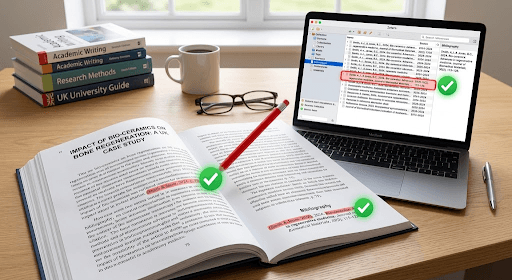
At a UK university when you submit a dissertation you are showing months or even years of research, analysis and steady writing work that has been added into your dissertation. The dissertation proofreading checklist becomes a demonstration of all the work you have done.
Referencing is often neglected when submissions are approaching. Many students add referencing at the end of a 10,000–15,000 word dissertation after a late‑night coffee‑filled editing session.
Citations and bibliographies, however, are more than just style requirements in British higher education.
They serve as the foundation for “academic integrity referencing”, representing your scholarly rigor and displaying your ability to engage in scholarly conversation in an appropriate manner.
This thorough guide dissects the crucial “dissertation proofreading checklist”, explaining the precise citation errors that cost students valuable marks, how external examiners examine your reference lists, and how working with experts can protect your final grade.
Why Should Referencing Proofreading Be Done?
In the last phases of writing, a lot of students ask themselves: *Is it really necessary to spend ten hours verifying commas and publication years in a reference list?* The answer is categorically “yes.” Scientific Proofreading Services is one of the best ways UK dissertation can get your referencing done right.
It’s important to proofread your references in order to avoid serious academic consequences, not only to make a document appear neat. Here’s why it’s crucial to perform a comprehensive citation check:
Eliminating Ghost Citations:
The “ghost reference” is a source that shows up inside a paragraph, for example “Smith, 2019* but it never makes it into the reference list because it was eliminated during structural revisions. The “ghost reference” appears often in long‑form writing.
Ensuring Style Compliance:
Universities in the UK require to follow manuals such as Harvard APA referencing, APA 7th, IEEE, OSCOLA and Chicago. They have guidelines for punctuation, volume numbers, capitalisation and italics, in each style. Combining elements from different referencing styles can therefore create inconsistencies.
Verifying Source Traceability:
Academic examiners use your references to trace your assertions to the original data. Errors that occur such as a publisher location is wrong, a DOI link is broken or if an author’s name is misspelled can make your source unverifiable.
Protecting Academic Reputation:
Respect for intellectual property is demonstrated via accurate reference. Even inadvertently failing to properly credit sources can cause Turnitin and other automated plagiarism detection technologies to raise red flags.
What Impact Can Proper Referencing Accuracy Create?
Examining the evaluation standards established by UK university marking boards is necessary to comprehend “Why do referencing errors matter in a dissertation?” Your reader will be profoundly affected both visually and intellectually by your bibliography’s precision.
Immediate Examiner Confidence
When an examiner reads a submission and sees that the reference list is well formatted and well aligned, he immediately thinks that the student is a hardworking researcher.
On the flip side, errors in formatting on the first few pages cause the marker to be on a higher alert and be more distrustful of your views. Academic markers read dozens of dissertations and thesis editing every upcoming season.
Maximising Marks Under “Presentation and Rigour” Criteria
Standard “marking criteria dissertation” rubrics at the majority of British colleges direct 10% to 15% of all possible points to “Structure, Presentation, Formatting, and Referencing.” Obtaining these grades can improve your overall degree classification on its own.
Demonstrating Scholarly Maturity
Gaining proficiency in “referencing accuracy in academic writing” demonstrates your understanding of the history of concepts in your subject.
It demonstrates your ability to discern between non-academic online sources and original research paper editing, secondary commentary, and peer-reviewed journal publications.
How Will Thorough Citation Checking Benefit Your Final Grade?
You get instant, quantifiable benefits when you carefully check your citations against a rigorous checklist or use professional dissertation editing services:
Safe Marks Retention:
Evaluators trim your dissertation through the dissertation proofreading checklist method for technical errors so you “avoid losing marks.” These are “free” marks that merely need careful editing and no more original research.
Turnitin Risk Mitigation:
Unquoted direct matches or improper citation styles are flagged as possible copies by plagiarism software. Clean in-text citations guarantee that formatting errors are not reflected in your similarity index, but rather proper academic attribution.
Stress Reduction Before Submission:
It gives you a great piece of mind to know that there are no broken links or missing items in your bibliography as you approach the final submission deadline.
Higher Post-Graduate Potential:
A perfectly edited dissertation is a great writing sample for PhD applications or publication in peer-reviewed publications, especially at the Master’s level.
The Ultimate Dissertation Proofreading Checklist
Before submitting your dissertation, make use of this practical checklist. “In-Text Citations” and “Bibliography/Reference List” are the two phases of your inspections.
In-Text Citation Checks
- Author Name Consistency: Make sure that authors’ surnames are spelled correctly and stay the same over the text and reference list. For example the authors’ surname “Smythe” must not be written “Smith”.
- Et Al Formatting: Use “et al” in accordance, with the reference style. You should consistently check the style guide to identify when “et al” should be used and ensure that the abbreviation is followed by a stop. For example “Andrews et al, 2019”.
- Direct Quote Page Numbers: Make sure every direct quote has its unique page number or paragraph number and check each one carefully. (e.g., “p. 45” or “pp. 112-114”).
- Secondary Referencing Limits: Reduce citations whenever possible. If you see a reference such as “Brown, 2010 cited in Taylor, 2018 ” try to find Brown’s 2010 source and cite Brown’s original directly whenever possible.
- Chronological Order in Multi-Citations: Keep the use of secondary citations to a minimum. If a source is cited as “Brown, 2010, cited in Taylor, 2018,” try to locate the original work by Brown (2010) and cite it directly whenever possible.
Bibliography & Reference List Checks
- Alphabetical Order: Make sure the first author’s last name is used to alphabetise the whole bibliography, not by source type. unless required by OSCOLA/ legal forms in particular).
- Hanging Indents & Spacing: Make sure that the reference list is utilising a hanging indent of 0.5 inches (1.27 cm). Also that the line spacing is aligned with the required style guide of your university.
- Capitalisation Styles: The first word and proper nouns are capitalized in article titles. The journal titles are written in title case for example APA, Harvard and other styles.
- URLs and Digital Object Identifiers (DOIs): Digital object identifiers (DOIs) for journal papers should be included and should have working links, in the style: [https://doi.org/](https://doi.org/).
Common Referencing Errors vs Correct Execution
The comparison table below lists common errors students make across major UK university referencing styles along with their rectified versions to assist you spot subtle in-text citation issues and bibliography formatting guidelines:
| Referencing Style | Common Error (Costs Marks) | Correct Execution (Passes Audit) | Error Explanation |
| Harvard (UK) | According to (Wilson 2021, p.45), climate policies… | According to Wilson (2021, p. 45), climate policies… | Incorrect bracket placement for narrative citations; missing space after ‘p.’. |
| APA 7th Edition | Smith, J., & Jones, M. (2020). The Future of AI. Journal of Tech, 12(4), pp. 15-20. | Smith, J., & Jones, M. (2020). The future of AI. Journal of Tech, 12(4), 15–20. | Capitalised article title incorrectly; added unnecessary ‘pp.’ prefix for journal pages. |
| OSCOLA (Law) | Lord Bingham, The Rule of Law (2010) Penguin Books, p. 12. | Tom Bingham, The Rule of Law (Penguin Books 2010) 12. | Included formal title (‘Lord’); misarranged publication details and page punctuation. |
| IEEE (Engineering) | As shown by Smith [1], and later expanded by [2] Jones… | As shown by Smith [1], and later expanded by Jones [2]… | Misplaced bracketed numeric citation after the author’s name instead of preceding/following correctly. |
Major Referencing Mistakes That Silently Reduce Grades
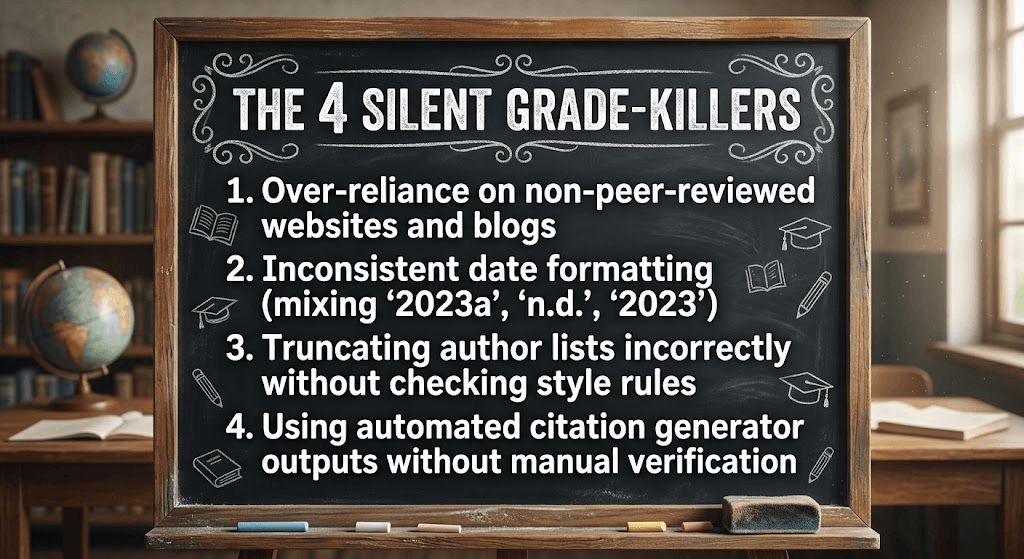
Beyond simple typos, students who misinterpret academic sourcing guidelines make a number of technical “mistakes that reduce dissertation grade” results.
Blindly Trusting Reference Management Software
Although Mendeley, EndNote, and Zotero are excellent tools for organising research, the quality of their automated exports depends on the quality of the imported raw metadata. There are obvious formatting errors when unedited automatic outputs are submitted, without the implementation of dissertation proofreading checklist.
Confusing Bibliography vs Reference List
Although the terms have different meanings in UK academia, many students use them interchangeably. List of references that “only” contains the sources you specifically cited in your dissertation’s body and how it aligns with the dissertation proofreading checklist.
All background reading and fundamental texts you reviewed during your study are included in the bibliography, even if they aren’t specifically referenced in the paper.
Instant mark deductions under layout compliance occur when you use a Bibliography layout when your guide expressly requires a Reference List (or vise versa).
How Examiners Check Referencing: Behind the Marking Process
You must comprehend “how examiners verify referencing” during the grading process in order to properly detect problems.
- The Spot-Check Audit: Markers regularly choose five to ten in-text citations at random from your main empirical chapters and verify that they are present in the reference list with full metadata.
- The Currency and Balance Scan: Examiners check the quality and age of your sources by turning to the bibliography. Your score is instantly reduced if your reference list is primarily made up of websites rather than peer-reviewed literature.
- The Check for Format Consistency: Markers check the overall design: Do book titles always have italics? Are journal article titles written in sentence case or title case?
Frequently Asked Questions
Referencing errors matter because referencing errors weaken credibility. Referencing errors also increase the chance of triggering plagiarism alerts, on Turnitin.
Yes, systemic or serious referencing problems such as unreferenced sources, missing references, or unverifiable citations, can ruin dissertations.
The UK institutions have very rigorous standards on reference to maintain academic integrity.
A reference list contains the sources that you mention directly in your writing, whereas a bibliography contains the background reading.
Examiners spot-check in-text citations, against the reference list.
The common mistake that can occur is the name of the author or the year in the text, that does not match the entry in the reference list.
Professional services meticulously cross-reference citations, correct formatting mistakes, and ensure total compliance with UK university criteria to help protect your marks.
Securing Your Academic Success Through Precise Referencing
Before you submit your journal papers take a look at the proofreading checklist to make sure that you have formatting, citations, references and overall presentation aligned according to the requirements.
Further, if you want to have reassurance about your work, then Scientific Proofreading Services can actually help you identify your mistakes very accurately that may occur.
This way there is a surety that your final dissertation really does reflect the depth, effort and quality of your research. Moreover, it is heavily emphasisised to recheck your citations after the research process has ended.
It is an important part of the procedure and strongly strengthens the academic work and integrity, without mistakes. To ensure that you earn excellent marks you need to make your citations accurate.