
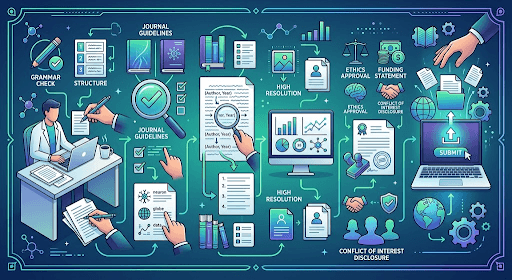
Writing a research paper ask for months of hard work. But getting it ready for a journal is a different job. This job is called manuscript preparation.
For layout, manuscript editing for language, manuscript formatting , and It also includes a final check of ethics and citations.
We will walk through every step in preparing a manuscript for publication and to help you avoid any mistakes in this guide.
What Is Manuscript Preparation?
Manuscript preparation covers many small jobs. Skip a step, and your journal may get rejected before anyone even reviews it in the worst case.
Checking your writing and formatting structure of your paper and checking references before you send it to a journal is what manuscript preparation means.
Manuscript preparation works the same way as before a trip, packing a suitcase. Before you leave the house you check everything twice.
Why Manuscript Preparation Matters So Much
Journal editors have a highly demanding schedule.. They read hundreds of papers every single month. A messy paper makes their job harder.
It also shows that your research is serious and ready. Good manuscript preparation can speed up the review process.
It can lower your chance of rejection too. It can even help your paper get accepted faster overall.
What Happens If You Skip Manuscript Preparation?
Some authors rush to submit their paper too soon. This often leads to what is called a desk rejection.
A desk rejection means the editor says no without sending it for review. This can happen because of poor formatting, weak writing, or the wrong journal choice.
Desk rejections waste your time and delay your publication. They can also feel discouraged after months of hard research work.
12 Easy Steps to Prepare Your Research Paper for Journal Submission
But worry not! By following a few simple steps, you can make your submission of a research paper for the journal easier.
Step 1: Read the Journal Guidelines First
Every journal has its own rules. These rules are called ‘author guidelines‘ or sometimes submission guidelines.
You can usually find them on the journal’s website. Before you start writing, take a little time to read these rules. They tell you:
- How many words your paper can have
- Which font and font size to use
- How to format your paper
- How to write your title page
- How to format headings
- Which reference style to use
Step 2: Organize Your Manuscript
Now it is time to give your paper a clear structure. Many research papers use a structure called IMRaD. It stands for:
- Introduction
- Methods
- Results
- Discussion
Structure makes your paper easier to read, but it should be clear. It also helps reviewers without getting lost to understand your research.
Step 3: Check Your Title and Abstract
The first thing readers see is your title. So, make it clear and easy to understand. A good title should:
- Be short
- Tell readers what your study is about
- Use simple words
- Avoid confusing or fancy language
Next comes your abstract.
the abstract of your whole paper, think of it as a tiny summary. It should briefly explain:
- What you studied
- Why you studied it
- How you did the study
- What you found
- What your results mean
Step 4: Edit Your Manuscript
This is where manuscript editing comes in. Checking your paper for grammar, manuscript editing, spelling, sentence flow, and clarity is what it means.
During editing, check for:
- Grammar mistakes
- Spelling errors
- Long or confusing sentences
- Repeated words
- Unclear ideas
- Poor word choices
Step 5: Check Your Manuscript Formatting
Manuscript formatting is about how your paper looks. It includes things like:
- Font
- Font size
- Line spacing
- Margins
- Headings
- Page numbers
Here are some common formatting rules:
| Element | Common Requirement |
| Font | Times New Roman or Arial |
| Font Size | 11pt or 12pt |
| Line Spacing | Double spaced |
| Margins | 1 inch on all sides |
| Page Numbers | Bottom right corner |
| Headings | Follow the journal’s rules |
Step 6: Check Your References and Citations
References are a big part of your research paper. First, check every citation in your paper. Make sure it also appears in your reference list.
Then check the reference style your journal wants. Check small details such as:
- Author names
- Publication dates
- Journal names
- Page numbers
- Commas and full stops
- Links or DOIs, when required
Step 7: Check Your Tables, Figures, and Images
Tables and figures help readers understand your research. Make sure everything is neat, clear, and easy to read.
Check that:
- Tables are numbered correctly
- Figures are numbered correctly
- Every table and figure has a caption
- The images are clear
- The image quality is good
- You use the file type requested by the journal
Step 8: Check Ethics and Author Details
Research ethics are very important.
If people, animals, or medical data are involved in your study or maybe other sensitive research areas, check the journal’s ethics rules carefully.
You may need to include:
- Ethics approval information
- Informed consent details
- Disclosure statements
- Funding information
You should also check your author details.
Make sure:
- All authors are listed
- Names are spelled correctly
- Affiliations are correct
- The author order is agreed upon by everyone
It is especially important, for medical writing, to follow accepted authorship and writing standards.
Step 9: Make Sure You Picked the Right Journal
The right journal is super important to choose. Look at some papers the journal has published recently.
Before submitting, check:
- Does the journal publish research like yours?
- Does your topic fit its scope?
- What types of papers does it accept?
- What is its review process?
- How long does a review usually take?
- What are its submission rules?
Step 10: Write a Simple Cover Letter
with your paper Some journals ask for a cover letter. Keep it short and polite, do not make it too long, and also keep it clear.
Your cover letter should tell the editor:
- The name of your paper
- What your research is about
- Why it fits the journal
- Why the research is useful or important
- That the paper is original
- That it is not being reviewed by another journal
Step 11: Proofread Your Paper One More Time
You have your paper that is edited. You have checked the formatting. Now, give it one final look.
slowly from beginning to end Read your paper. Reading it out loud can help you notice sentences that sound strange or confusing.
Also check:
- Spelling
- Grammar
- Headings
- Page numbers
- Tables
- Figures
- References
- Title page
- File names
Step 12: Run a Plagiarism Check
For copied text, check your paper before you submit. Journals often screen submitted papers for plagiarism.
Copied text can cause problems, even in a small amount. To review your paper before submission, use a trusted plagiarism checker.
Manuscript Preparation Checklist
Use this simple checklist before you hit submit.
| Task |
| Read journal guidelines |
| Structure follows IMRaD |
| Title and abstract checked |
| Grammar and spelling checked |
| Formatting matches journal style |
| References checked and styled correctly |
| Tables and figures numbered and captioned |
| Ethics and author details included |
| Cover letter written |
| Final proofread completed |
Common Manuscript Mistakes to Avoid
Here are the mistakes authors make most often.
| Mistake | Why It’s a Problem |
| Ignoring journal guidelines | Leads to quick, avoidable rejection |
| Weak abstract | Fails to grab the editor’s attention |
| Inconsistent references | Confuses reviewers and slows review |
| Poor English | Distracts readers from good science |
| Wrong journal choice | Wastes months of review time |
| Missing ethics statement | Can stop the review process entirely |
| Low-quality images | Causes delays or revision requests |
Manuscript Preparation for Different Paper Types
A research paper, a review paper, and a case study each need different care. Research papers need strong methods and results sections.
Review papers need a wide, well-organized reading of past studies. Case studies need clear patient or subject details, written with care and ethics in mind.
Thesis chapters being turned into papers often need extra trimming and rewriting.
How Long Does Manuscript Preparation Take?
This depends on your paper’s length and current condition. A short, clean paper may only take a few days to prepare.
| Paper Condition | Estimated Time |
| Short, clean draft | 2 to 4 days |
| Average draft with some issues | 1 to 2 weeks |
| Long or messy draft | 2 to 4 weeks |
| First-time submission | Add extra buffer time |
Benefits of Professional Manuscript Formatting Services
Not everyone has time to fix every small formatting detail. This is where manuscript formatting services can really help.
Experts know journal rules inside and out. They can format your paper quickly and correctly. They also catch small errors that busy authors often miss.
Manuscript Requirements Can Vary by Field
Different research fields often have slightly different expectations. Medical journals may ask for strict ethics and consent details.
Engineering journals may focus more on data and technical figures. Social science journals may expect longer literature reviews.
Always check field-specific guidance alongside the general journal rules.
| Field | Extra Focus Area |
| Medical and health sciences | Ethics approval and patient consent |
| Engineering and technology | Data accuracy and technical diagrams |
| Social sciences | Detailed literature review and methodology |
| Life sciences | Data reproducibility and sample details |
Helpful Tools for Manuscript Preparation
Many free and paid tools can support your manuscript preparation work. Tools are helpful, but they cannot replace a careful human review.
| Tool Type | What It Helps With |
| Grammar checker | Spelling, grammar, and punctuation |
| Reference manager | Organizing and formatting citations |
| Plagiarism checker | Spotting copied or unoriginal text |
| Word counter | Staying within journal word limits |
| File converter | Matching the journal’s required file type |
Frequently Asked Questions
What is the difference between manuscript editing and manuscript formatting?
Manuscript editing fixes grammar and writing. Manuscript formatting fixes how the paper looks, like fonts and spacing.
Do I need manuscript formatting services?
Not always. But manuscript formatting services can save time and reduce errors, especially for first-time authors.
How long does manuscript preparation take?
Depending on your paper’s length and condition, it can take a few days to a few weeks
What should I check before submission?
Check journal guidelines, structure, grammar, formatting, references, tables, and ethics details, and do a final proofread.
Can I prepare a manuscript myself?
Yes, many authors do. But professional help can catch mistakes and save time, especially for first submissions.
Ready to Submit?
Good manuscript preparation is not about being perfect. It is about being careful, organized, and patient. Take time to follow each step in this guide. Read your journal’s guidelines closely before you begin.
Fix your writing with careful manuscript editing. Clean up your layout with proper manuscript formatting. With these steps done, preparing a manuscript for publication becomes far less stressful.
Your research deserves a fair chance at success and a well-prepared manuscript gives it exactly that.