
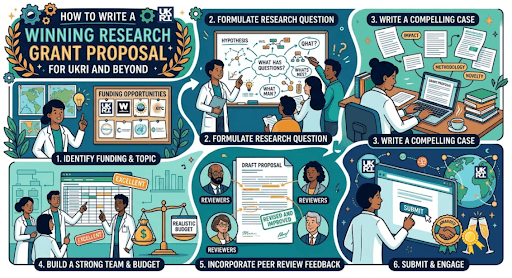
Securing funding is one of the most demanding parts of an academic career, and writing a competitive research grant proposal requires far more than good science. It requires clarity, structure, and an understanding of exactly what reviewers are looking for.
Whether you are applying to UKRI, Horizon Europe, or a smaller trust fund, the fundamentals of a persuasive proposal remain the same: a clear question, a credible method, a realistic budget, and a compelling case for impact.
This guide walks through every stage of building a research grant proposal that stands out from the pile, with practical UKRI grant funding application tips, guidance on structuring a research project proposal, and advice that applies equally to UK councils and European schemes.
If you are preparing your first submission or refining a proposal that has been rejected before, the principles below will help you present your research in the strongest possible light.
At Scientific Proofreading, we work with researchers across disciplines to polish grant applications before submission. We have seen first-hand which mistakes cost applicants funding and which techniques consistently improve scores. This article distils that experience into a practical framework you can apply to your own proposal today.
Why Grant Writing Is a Distinct Skill
Writing a research grant proposal is not the same as writing a journal article. A journal article assumes an audience of specialists who already understand the field and are evaluating completed work.
A grant proposal, by contrast, is read by a panel that may include generalists, early-career reviewers, and subject experts working to a tight schedule and a scoring rubric.
Your job is not simply to describe your research; it is to persuade a diverse panel, quickly, that your project deserves scarce public money over dozens of competing applications. This distinction matters because it changes how you write. Sentences should be shorter. Jargon should be minimised or explained.
Every section should answer an implicit question: why does this matter, why are you the right person to do it, and why now? Reviewers who are reading forty applications in a week will reward clarity and penalise ambiguity, however brilliant the underlying science.
Understanding the UKRI Landscape
UK Research and Innovation (UKRI) brings together seven research councils, Research England, and Innovate UK, and each council has its own priorities, panel culture, and application format.
The UKRI permits the use of generative AI to draft or edit grant proposals. However, applicants must be fully transparent, declare any substantive AI use, and remain completely responsible for the final content. Failure to disclose AI assistance may result in application rejection.
Before writing a word of your proposal, it is worth reading recent funding decisions and panel feedback summaries published by your target council, since these often reveal what separates funded projects from rejected ones far more precisely than the official guidance notes.
Some practical UKRI grant funding application tips that apply across councils include the following:
Read the call specification twice before drafting
Many rejected proposals fail not because the science is weak, but because the application does not directly address the priorities stated in the call. Panels are instructed to score against specific criteria, and a proposal that ignores those criteria, however excellent, will lose marks it cannot recover elsewhere.
Contact the programme office early
UKRI programme managers are generally happy to answer eligibility questions and clarify ambiguous wording in the call document. A short email early in the process can save weeks of wasted drafting on an ineligible idea.
Align your track record section with the specific call
Reviewers want evidence that you, or your team, can deliver this particular project, not a general summary of your career. Select prior outputs and experience that map directly onto the proposed work.
Respect the word and page limits precisely
UKRI systems often reject or truncate applications that exceed stated limits, and panels notice when applicants have tried to circumvent formatting rules with condensed fonts or narrow margins. Discipline in formatting signals discipline in research management.
Structuring a Research Project Proposal
Good structuring a research project proposal is arguably the single most controllable factor in a successful application, because unlike the underlying science, structure is entirely within the applicant’s control.
A well-structured proposal guides the reviewer through your logic without effort, while a poorly structured one forces the reviewer to hunt for information, which invariably lowers scores.
Most funders, whether UKRI, a Horizon Europe consortium, or a charitable trust, expect some variation of the following core sections.
1. Title and Summary
Your title should be specific and memorable rather than vague or overly technical. The lay summary, often the only section read by non-specialist panel members or external assessors, should explain the research question, its significance, and the expected outcomes in plain language, avoiding acronyms wherever possible.
2. Background and Rationale
This section establishes the gap in current knowledge that your project will fill. Rather than reviewing the entire field, focus tightly on the specific gap your research addresses, and be explicit about why closing that gap matters scientifically, socially, or economically.
3. Aims and Objectives
State a single, clear overarching aim, followed by three to five measurable objectives. Vague aims such as “to explore” or “to investigate” are weaker than aims framed around testable hypotheses or clearly defined deliverables.
4. Methodology
This is where many proposals lose marks through insufficient detail or unjustified choices. The methodology section should follow recognised scientific methodology review guidelines, meaning every method chosen should be explicitly justified, potential limitations acknowledged, and alternative approaches briefly addressed where relevant.
Reviewers are trained to look for evidence that the proposed methods can actually answer the stated research question, not merely that they are fashionable or familiar to the applicant.
Include a realistic timeline, ideally presented as a Gantt chart or milestone table, showing how work packages relate to one another and where key risks or dependencies lie.
5. Impact and Dissemination
Funders increasingly require applicants to demonstrate value beyond academic publication. This section should describe concrete plans for demonstrating research impact metrics, engaging stakeholders, and translating findings into policy, practice, or further innovation.
6. Budget Justification
Every cost should be tied explicitly to a project activity. Padded or vague budget lines are one of the fastest ways to raise reviewer suspicion, while a tightly justified budget signals careful project management.

Structuring for Horizon Europe
If you are applying beyond the UK, a Horizon Europe proposal writing guide should sit alongside your domestic funding strategy, since the European Commission’s evaluation criteria differ meaningfully from UKRI’s.
Horizon Europe proposals are typically assessed against three criteria: excellence, impact, and quality and efficiency of implementation, each scored separately and often with a minimum threshold that must be met regardless of overall score.
Excellence covers the scientific quality of the proposed work and its ambition relative to the state of the art. Impact requires applicants to articulate expected outcomes in terms of the specific expected impacts listed in the call topic, not generic claims about scientific advancement.
Implementation quality assesses the consortium’s structure, work plan, and resource allocation, meaning that for collaborative proposals, the composition and complementarity of partners matters as much as any individual partner’s excellence.
A key difference from UKRI applications is the emphasis on consortium building. Horizon Europe strongly favours multi-country partnerships, and reviewers expect a clear division of labour, demonstrated complementary expertise, and evidence of prior collaboration or a credible plan for managing a distributed team.
Demonstrating Research Impact Metrics
Demonstrating research impact metrics convincingly is increasingly central to funding success across almost all major schemes, including UKRI’s Pathways to Impact framework successors and Horizon Europe’s impact pathways. Reviewers want more than a promise that research will “contribute to knowledge”; they want a credible, specific account of who will benefit, how, and by when.
Effective impact sections typically include a mix of academic impact metrics, such as anticipated publications and citation pathways, and non-academic impact evidence, such as engagement with policymakers, industry partners, or public bodies. Improving the academic writing style is a must for UK university students.
Where possible, reference named stakeholder organisations who have expressed interest in the research, and attach letters of support where the funder allows this. Quantified targets, even approximate ones such as an expected number of workshop participants or a target policy consultation, carry more weight with reviewers than open-ended aspirations.
Postdoctoral Funding Application Layout
Early-career researchers applying for fellowships face a slightly different challenge, since panels are assessing both the project and the applicant’s readiness to lead independent research.
A strong postdoctoral funding application layout typically foregrounds the applicant’s development plan alongside the research plan, showing how the fellowship will build specific new skills, expand the applicant’s network, and position them for a permanent academic role.
Postdoctoral proposals benefit from a clear division between the research narrative and a dedicated training and development section, since panels for fellowship schemes are often specifically instructed to weigh career development alongside scientific merit.
Mentorship arrangements, host institution support, and a realistic publication and dissemination plan should all be addressed explicitly rather than assumed.
The Academic Abstract Editing Checklist
The abstract or summary is frequently the most-read section of any application, and yet it is often written last, under time pressure, and without proper revision. Using a consistent academic abstract editing checklist before submission can catch weaknesses that are easy to miss after weeks of drafting.
Before submitting, check that your abstract states the research question in the first two sentences, avoids field-specific jargon that a general panel member might not recognise, quantifies the significance of the problem where possible, briefly names the core methodology without excessive technical detail, and closes with a clear statement of expected outcomes and their significance.
Reading the abstract aloud, or asking a colleague outside your subfield to read it, is one of the most effective ways to catch unclear phrasing before submission.
Common Mistakes That Cost Applicants Funding
Even strong researchers with excellent ideas frequently lose funding over avoidable errors. The most common issues we see when reviewing applications include proposals that describe what the research is about without ever stating why it matters, methodology sections that list activities without justifying method choice, budgets that are either unrealistically low or padded without explanation, and impact sections that rely on vague claims rather than specific, credible outcomes.
Another frequent problem is inconsistency between sections, where the stated aims do not quite match the objectives, or the budget does not correspond to the work packages described in the methodology. Panels notice these mismatches, and they undermine confidence in the applicant’s project management ability, regardless of the underlying research quality.
Final Review Before Submission
Before submitting any research grant proposal, build in time for at least one full round of external review from a colleague or professional editor unfamiliar with the fine details of the project.
A fresh reader will quickly spot unclear passages, unjustified jumps in logic, or formatting inconsistencies that are invisible to someone who has read the document dozens of times during drafting. Academic editing and academic proofreading services are the best options to avoid this.
Professional proofreading services and structural reviews are particularly valuable for non-native English speakers, interdisciplinary teams merging different writing styles, and applicants submitting to multiple funders where language and formatting requirements differ subtly between UKRI and Horizon Europe templates.
If you would like expert eyes on your next application, Scientific Proofreading offers dedicated grant proposal and journal article editing services covering language, structure, and formatting compliance, giving your submission the best possible chance before it reaches the panel.
Frequently Asked Questions
How long should a UKRI research grant proposal be?
Applicants must check specific council documents for length requirements, typically 6-12 pages for core proposals, as exceeding limits can lead to rejection or negative reviewer impressions.
What is the biggest reason research grant proposals get rejected?
Strong research often fails to secure funding due to mismatches between proposals and call priorities, unclear writing, or lack of external review. Explicitly addressing call specifications significantly improves the chances of success.
How is a Horizon Europe proposal different from a UKRI application?
Horizon Europe evaluates applications on excellence, impact, and implementation quality with distinct scoring, emphasising multinational consortia, while UKRI typically uses integrated scores; strategies for each must differ significantly.
Should I hire a professional editor for my grant proposal?
Professional editing enhances clarity, consistency, and formatting compliance, improving reviewer scores, especially for non-native speakers, interdisciplinary teams, and early-career researchers, allowing timely fixes before submission deadlines.
Get Ready To Strengthen Your Next Application
Scientific Proofreading Services in the UK provides specialist editing and proofreading services online for UKRI, Horizon Europe, research grant proposals, and postdoctoral fellowship proposals. Get in touch to discuss your submission timeline.