
A paper can contain sound data and still feel difficult to review when the sections do not answer the questions editors expect in sequence. Knowing how to structure a research paper fixes that problem early.
For UK researchers preparing an original article, the safest starting point is the target journal’s author instructions, then the reporting standard for the study design. Let us dive into the structure of the research paper for starters.
What Is the Structure of a Research Paper?
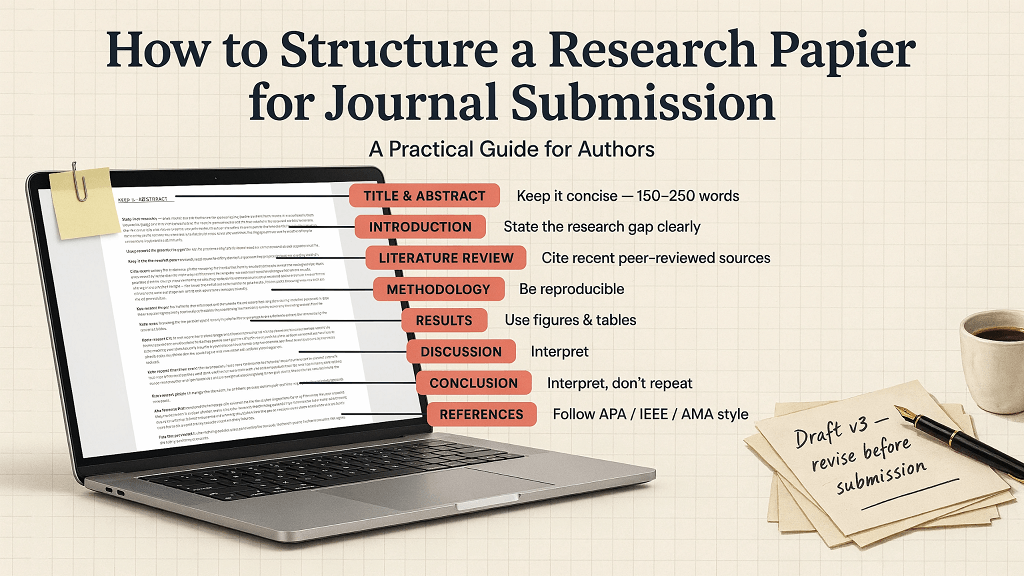
Research papers usually follow a pattern. First a title appears, an abstract that gives a quick summary of what the whole research paper is about. After that a research paper opens with an introduction to the topic. The next part of a research paper explains the methods that were used.
In the fourth part a research paper shows the results that were found. After that comes a conclusion or closing discussion. The references that were cited are listed down at the end.
The structure includes Introduction, Methods, Results, and Discussion and most people know it as IMRaD, which The ICMJE manuscript recommendations describe this format as a mirror of how scientific discovery actually unfolds, step by step.
At the same time, they’re clear that not every kind of paper fits neatly into it. Reviews, meta-analyses, and other article types often need their own layout.
This is something to remember when you start planning how to organize a paper. A qualitative study, a trial, a systematic review and a humanities article can all perform the same academic task, share a clear story, support it with proof and contribute something new to the area without ever having the same set of headings.
How to Structure a Research Paper Step by Step
Start with the journal. The research paper format should follow the journal’s article type, word limits, section order, reference style, figure rules and required declarations.
A practical journal article structure can be mapped before drafting. Scientific Proofreading’s pre-submission checks explain the technical checks that follow once the paper itself has a stable structure.
1. Build the title page for research paper
The title page identifies the article, authors, affiliations and corresponding author. Depending on the journal, it may also carry word counts, acknowledgements, funding details, conflicts, author contributions or a running title.
A useful title names the central subject and, when relevant, the study design or population. Avoid abbreviations that a database user or researcher outside your narrow speciality would struggle to recognise.
Author details and declarations
Agree author names, order and affiliations before upload. UKRIO’s 2025 Code of Practice for Research covers publication, authorship, competing interests, data management and research integrity across the research lifecycle.
2. Write the research paper abstract after the main paper
The abstract has very little room for background. It needs the study purpose, essential methods, principal findings with useful quantitative detail where applicable, and a conclusion supported by those findings.
Journal rules decide whether the abstract is structured and which headings it uses. ICMJE currently recommends structured abstracts for original research, systematic reviews and meta-analyses in medical publishing and stresses consistency with the full article.
If you are learning how to structure a research paper, draft the abstract later. Results, sample numbers and conclusions often change during revision, making an early abstract easy to leave out of sync.
3. How to Write a Research Paper Introduction
A solid introduction outlines the issue, highlights the pertinent gap, and concludes with the aim of the study, research question, or hypothesis. A condensed overview of the whole discipline is unnecessary.
To structure a research paper, visualize the introduction as a converging pathway: established context, ongoing problem, motivation for this research, followed by the specific question being investigated.
The site’s coverage of scientific writing for high-impact journals is beneficial when clarity is an issue in those sections, particularly when technical details have become overly complex or redundant.
4. How to Write a Literature Review inside a journal article
Many empirical journal papers do not contain a standalone literature review. Relevant prior work is often concentrated in the introduction and returns selectively in the discussion when the findings are interpreted.
A separate review section makes sense when the discipline, article type or journal expects one. Organise it around debates, evidence, methods or unresolved questions instead of summarising one paper after another.
A useful drafting habit is to outline the paper’s storyline before writing full paragraphs. Literature earns space when it establishes the research problem, justifies a choice or helps interpret the findings.
5. Methods: make the study reproducible
Methods should tell another qualified researcher what was done, with detail to assess or reproduce the work. Include design, setting, participants or materials, procedures, measures, analysis, software and ethics where relevant.
Research paper writing guidelines become discipline specific. Everything from trials to observational studies, qualitative research to laboratory experiments each has its own reporting rules. That is why, always check research paper writing guidelines, with the journal instructions.
For randomised trials, the CONSORT 2025 statement contains a 30-item checklist and flow diagram. It asks authors to report essential design, conduct, analysis and results information transparently.

6. How to Write the Results Section
Results answer what the study found. Show outcomes in an order that follows the methods. Begin with the outcomes. Use tables or figures when they show patterns more efficiently than prose.
Knowing how to structure a research paper also means managing repetition. If a table has twelve values the paragraph should point out the result that’s important; it does not need to explain every single cell.
Report pre- outcomes even when they are not statistically significant. Keep the interpretation, for the discussion unless the specific journal uses a combined Results and Discussion section.
7. How to Write the Discussion Section
Open with the principal finding in direct terms, then explain what it means in relation to the research question and existing evidence. Address plausible explanations, limitations, implications and questions that remain unresolved.
A useful discussion does not replay the Results. It interprets them. This separation is one of the most important decisions when working out how to structure a research paper for conventional journal submission.
If structural problems remain after drafting, subject-aware research paper editing can check whether the abstract, introduction, results and discussion tell the same research story without changing the study’s meaning.
8. How to Write a Strong Research Conclusion
Some journals use a separate Conclusion; others expect the final discussion paragraph to do that work. Follow the target publication instead of adding a section because a generic template includes one.
State the answer the study can support, its practical or scholarly implication, and any justified next step. Avoid introducing fresh data, new citations or claims that extend beyond the reported evidence.
How to Format References for Journal Submission
Reference formatting begins with the target journal’s rules. A manuscript drafted in Harvard or APA may need Vancouver numbering, a publisher-specific author-date style, abbreviated journal names or a particular DOI format.
Before submission, match every in-text citation to the reference list and verify bibliographic details against original records. The site’s Harvard and APA referencing conventions also explain how journal requirements can supersede the style used during drafting.
This part of how to structure a research paper affects more than appearance. References should sit where claims need support, and the final list must follow the journal’s required order and punctuation.
How to Follow UK Journal Submission Guidelines
There is no single national research paper submission format used by every UK journal. British researchers should follow the target journal’s Instructions for Authors, their institution or funder requirements, and any study-specific reporting standard.
For UK research paper submission make sure to check open-access obligations. Also look at ethics wording, data availability and funding statements. Don’t forget authorship details and any conflicts of interest. If relevant, include disclosures about AI use. These points can be outside the structure but still need to be part of the final submission package.
When formatting requirements become extensive, manuscript formatting can align headings, citations, references, tables, figures and captions with the selected journal after the scientific content is settled.
What to Check Before Submitting a Research Paper
Once you know how to structure a research paper, run a section-to-section audit before uploading. The objective is consistency: each promise made early in the manuscript should be answered later with matching terminology and evidence.
Check these items separately rather than relying on one final read:
- The title accurately represents the study and article type.
- The abstract matches the final sample, methods, results and conclusion.
- The introduction ends with the actual objective or hypothesis.
- Methods contain enough detail for assessment and reproducibility.
- Results answer the prespecified questions and match tables and figures.
- Discussion claims remain within the evidence reported.
- References, declarations, ethics, funding and data statements are complete.
- Files, figure formats and supplementary materials follow journal submission guidelines.
If the target journal has already been chosen, journal selection and submission support can also help check the manuscript package, cover letter and required files before final author approval.

Common Research Paper Structure Mistakes to Avoid
Structural errors are usually local. A paper becomes harder to review when the objective changes between sections, methods appear only after results, or the discussion makes claims the data cannot carry.
Watch particularly for:
- a literature-heavy introduction that never identifies the research gap;
- methods that omit eligibility criteria, analysis choices or ethical approval;
- results organised by table number instead of research question;
- discussion paragraphs that repeat numerical results without interpretation;
- a conclusion that introduces a new argument;
- inconsistent terminology for the same outcome, group or variable;
- references formatted before the target journal has been confirmed.
Research paper editing should catch these cross-section inconsistencies. It should also preserve the author’s scientific meaning, because structural clarity depends on accurate relationships between the question, method, evidence and interpretation.
Frequently Asked Questions
No universal structure fits every article type. IMRaD is common for original empirical research, and the target journal may require a different order for reviews, case reports, qualitative studies or discipline-specific papers.
Often it does not. Many journal articles place essential literature in the introduction and discussion; a dedicated review section is appropriate when the field, article type or journal specifically expects one.
Yes, some journals permit a combined section. Check the author instructions first, then keep the finding and its interpretation clearly distinguishable so reviewers can see exactly what the data show.
There is no universal word count. Journals commonly specify an abstract limit and may require named subsections, so confirm the exact limit and structure before preparing the final submission file.
Choose the target journal early enough to prevent avoidable reformatting. Once selected, apply its section order, word limits, reference style, table rules, figure specifications and declaration requirements consistently.
A Structure Review Before the Journal Sees Your Paper
Ultimately an exercise in traceability is learning how to structure a research paper. The reader should be able to move from research problem to method, findings and interpretation without guessing why a section exists.
Prior to submission, examine the manuscript against the target journal line by line. Finalise the required document preparation. An organised format allows editors and reviewers to see the work you truly completed.
Scientific Proofreading UK can review the paper for clarity, consistency and submission readiness while keeping the research decisions with the author. Professional help is paramount after your manuscript is complete and the structure, language or journal formatting still needs a check.