
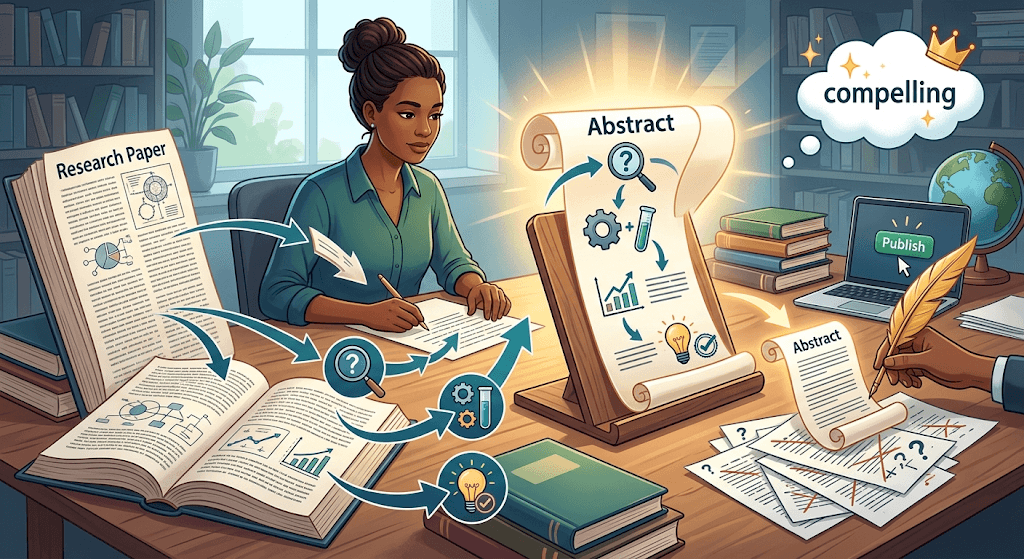
Are you aware of how to write a research abstract that grabs the attention of readers? The first thing is an abstract that people read. It is something that occupies the top of your paper, before the full research starts.
An abstract that does not feel too boring makes people want to read more, but if your research abstract is not interesting, it makes people drop reading before they even read the actual research.
Many students and researchers find abstracts hard to write. They are short, but they carry a big job. You must fit your whole study into a few hundred words.
This guide will help you. We will explain the abstract structure step by step. We will share simple abstract writing tips you can use today.
What Is an Abstract in Research?
The most asked question is what is an abstract in research, and why it holds so much importance in a research paper? For a quick answer, we can say it is an extract of the whole research paper. It takes up the space right after the title page, before the main text begins.
A good research abstract covers four things. It shares your topic. It shares your methods. It shares your results. It shares your conclusion.
Readers use abstracts to judge your work fast. Editors use them to check if a paper fits their journal. Databases show abstracts to millions of readers every single day.
This makes your abstract one of the most read parts of your whole paper. It often gets far more views than the full text ever will.
Why a Strong Research Abstract Matters
A clear abstract does more than just providing a short summary of your research paper to the readers. It plays many roles at the same time.
- It saves readers time. They can judge your work in seconds, not minutes.
- It helps search engines find your paper. This is important for SEO, since search engines skim abstracts for keywords.
- It helps the editors of the journals to decide on a fast basis if your paper will be a fit for their scope.
- It gives a helping hand to other researchers to correctly cite your work because there are many tools that pull data straight from the abstract.
- It builds trust in your writing from the very first line.
Types of Abstracts You Should Know
Every abstract is not the same, so knowing which type of an abstract you need is a plus that will help you write it the right way. There are four common types used across most fields.
| Type | What It Is | Best Used For |
|---|---|---|
| Descriptive Abstract | States what the paper covers, with no results | Short papers, conference proposals |
| Informative Abstract | Shares full details, including key results | Most journal articles and theses |
| Structured Abstract | Uses labelled sections like Background and Methods | Medical and science journals |
| Unstructured Abstract | Written as one flowing paragraph | Humanities and social science journals |
Always check your target journal’s author guidelines first. Some want a structured abstract. Others want one flowing paragraph.
Research Abstract Structure: The Four Key Parts
A strong abstract structure has four main parts. Each part has its own small job to do.
| Part | What to Include |
|---|---|
| Background | Why the topic matters, and the gap in current knowledge |
| Methods | How you did the study, and what tools or data you used |
| Results | Your key findings, written in plain and clear words |
| Conclusion | What your findings mean, and why they matter |
Keep each part short, at most, two or three sentences are likely enough to describe them.

How to Write a Research Abstract: Step-by-Step Guide
The steps stated below make the process of writing your abstract easy and free from any stress.
Step 1: Write Your Abstract Last
Write your abstract after you finish your full paper. This way, you already know your real results. It is hard to summarise work that is not done yet.
Step 2: State Your Research Question First
Start with your main question or goal. Tell readers what problem you tried to solve. Keep this part consisting of one or two sentences only.
Step 3: Explain Your Methods Briefly
Say how you did your study. Name your method, your sample size, or your tools. Do not go into deep detail here.
Step 4: Share Your Key Results
List your most important findings first. Use numbers where you can. Avoid unclear words like “many” because they do not state a clear idea of how many.
Step 5: State Your Conclusion Clearly
Tell readers what your results mean for the field. Say why your study matters. End with the bigger picture in mind.
Step 6: Add Keywords Naturally
Use words your readers might search for online. This helps your paper get found by both people and AI tools.
Step 7: Keep Sentences Short and Simple
Long sentences confuse readers fast, while short sentences feel much easier to read and aim to describe one clear idea in one sentence.
Step 8: Check Your Word Count
For abstracts, most of the journals have strict limits for word count which is the reason why you should check the list of guidelines closely before you submit your paper.
Step 9: Proofread With Fresh Eyes
Take a break from your abstract for about a day or two, then give it a read because when you read it with fresh eyes they can catch oversights that tired eyes from all that writing could have missed.
Abstract Writing Tips for a Stronger Result
Writing an abstract that feels really good does not have to be something that feels like a burden to execute. Some easy tips are as follows and will help you out:
- Use simple words. Try not to use big or confusing words.
- Do not put citations in your abstract. You can add them in the main part of your paper.
- If you use a short form, write the full meaning first.
- Use active voice when you can because it is way user friendly.
- Remove words that feel extra, like “very,” “quite,” and even “really.”
- Read your abstract loudly by yourself so that you can hear it as well when you read because your ears may notice sentences that sound strange.
- Ask a professional editor to attempt proofreading and editing on it and give you helpful feedback.
You can also follow the list of APA Style guidelines because these can help you make your abstract look correct, especially when you are writing a social science paper.
How Long Should a Research Abstract Be?
Abstract length depends on your field and your target journal.
| Field or Journal Type | Typical Word Count |
|---|---|
| Science Journals | 150 to 250 words |
| Medical Journals | Around 250 words, often structured |
| Social Science Journals | 150 to 300 words |
| Conference Abstracts | 200 to 300 words |
| Thesis or Dissertation Abstracts | 300 to 500 words |
Writing Abstracts for Theses and Dissertations
- A thesis or dissertation both have an abstract as a part of them, but both abstracts work a bit differently from an abstract of a journal. These abstracts are usually more extended, since they have to cover a much broader body of work.
- It should still follow the same four-part structure. Background, methods, results, and conclusion all still apply here.
- Focus on your overall contribution to the field. Do not try to summarise every single chapter in detail.
- Check your university’s own style guide too. Many schools have their own strict rules for dissertation abstracts.
Citation Styles and Your Abstract
Your citation style can affect small formatting choices in your abstract.
- APA style usually asks for a single paragraph, with no indent, under a bold “Abstract” heading.
- Harvard style often follows similar rules, though exact formatting can vary by university.
- Medical journals following ICMJE guidelines often expect a structured abstract with clear labelled sections.
Always check your specific style guide. Small formatting mistakes can distract readers from your strong content.
Examples: Weak Abstract vs Strong Abstract
Seeing a real example can help. Here is a short comparison.
A weak abstract might say: “This paper looks at climate change. It talks about some effects and offers some ideas.”
This is too vague. It has no clear method, no real results, and no strong conclusion.
A strong abstract might say: “This study measured rainfall changes across 20 UK regions over 10 years. Results show a 12% drop.”
It could continue: “These findings suggest UK farmers need updated water planning.”
Notice the difference. The strong version uses real numbers, a clear method, and a clear takeaway.

Breaking Down a Sample Abstract, Sentence by Sentence
Let’s look at the strong example again, but this time, label each part.
| Sentence | Part It Covers |
|---|---|
| “This study measured rainfall changes across 20 UK regions over 10 years.” | Background and Methods |
| “Results show a 12% drop in average rainfall.” | Results |
| “These findings suggest UK farmers need updated water planning.” | Conclusion |
See how each sentence does one clear job? Try this labelling trick on your own draft. It helps you spot missing parts fast.
Abstract vs Introduction: What Is the Difference?
Many students mix up the abstract and the introduction. They are not the same thing at all.
| Feature | Abstract | Introduction |
|---|---|---|
| Location | Before the main text starts | At the start of the main text |
| Length | Usually 150 to 300 words | Can run several paragraphs long |
| Purpose | Summarises the whole paper | Sets up the topic and background |
| Content | Covers methods, results, and conclusion | Covers background and the research gap only |
| Stands Alone? | Yes, it works on its own | No, it needs the rest of the paper |
Your abstract must make full sense on its own. Your introduction does not need to do that.
Using Keywords in Your Research Abstract
Keywords help your paper get found online by both people and machines.
They also help AI tools understand and share your work correctly. This matters for SEO, AEO, and GEO all at once.
Pick three to five keywords tied closely to your topic. Place them naturally inside your abstract text.
Do not force them in. Do not repeat the same keyword too many times either.
Databases like PubMed also let readers search by keyword, so strong keyword choice really helps.
A Simple Research Abstract Template You Can Use
Try this simple template as your starting point.
“This study looked at [your topic]. The goal was to [your research question]. We used [your method] with [your sample size]. Results showed that [your key finding]. These findings suggest [your conclusion]. This work adds to [your field] by [why it matters].”
You can just fill in each bracket with the details of your own and then adjust the wording accordingly so it flows smoothly.
Checklist Before You Submit Your Abstract
Run through this quick checklist before you hit submit.
- Does it state your research question clearly?
- Does it explain your methods in brief?
- Does it share your key results with real numbers?
- Does it end with a clear, strong conclusion?
- Is it within your journal’s word limit?
- Is it free of jargon and unnecessary citations?
- Has someone else proofread it for you?
Common Abstract Mistakes to Avoid
The following mistakes are listed below, avoid them and take a better approach:
| Mistake | Why It Is a Problem | Better Approach |
| Being too vague | Readers cannot understand what you found. | Give clear details and results. |
| Adding too much background | It takes space away from your actual study. | Keep the background brief. |
| Leaving out results | Readers cannot see what your study discovered. | Include your key findings. |
| Using too much jargon | It can make your abstract difficult to understand. | Choose simple words where possible. |
| Adding unnecessary citations | They can take attention away from the main summary. | Keep citations in the main text when appropriate. |
| Using unexplained abbreviations | Readers may not know what they mean. | Spell out the term the first time. |
How Scientific Proofreading Can Help
Writing a strong abstract takes real practice, and a second pair of eyes always helps. Our Research Paper Editing service checks your full paper, abstract included, line by line.
If your work is headed to a journal, we can provide you with a Journal Article Editing service to help you meet strict guidelines.
Other than that, our guide on how to prepare a manuscript before journal submission helps prepare for what comes next.
Frequently Asked Questions
It is a short summary of your full paper. It covers your topic, methods, results, and conclusion in one short block of text.
The four parts are background, methods, results, and conclusion. Each part plays its own small, important role.
Write it after. This way, you already know your real results and can summarise them with full accuracy.
No. Most journals ask you to avoid citations inside the abstract. Save those details for your main text instead.
It is best to avoid abbreviations in the abstract, but if you need to use one, spell it out in full the first time you mention it.
Ready to Write a Stronger Abstract?
Writing a good to read abstract is not something to take stress about. Just by following the steps given in this guide will make your worries go away. All you have to do is keep your sentences short and clear all along the abstract length.
Your topic should be covered, methods should be clearly defined, results should be precisely stated, and also the conclusion should follow in that same order. A good abstract opens the door to your full paper. It brings in more readers and more citations.
Take your time. Give it a read more than one time, and do not be afraid to ask for a helping hand with polishing and finalizing your draft.