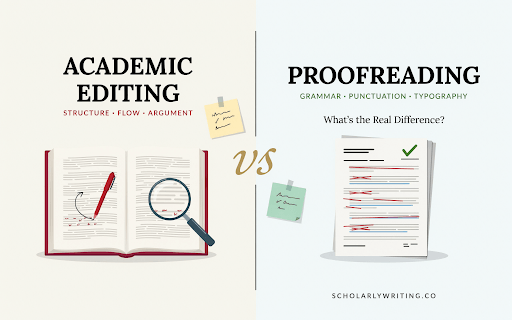
Students and researchers across the UK often use “editing” and “proofreading” interchangeably, but they are two different services that solve two different problems.
This blog explains exactly what academic editing covers, how it differs from proofreading, what academic editing services typically include, how rates are usually structured in the UK, and how services vary for essays, research papers, and dissertations specifically.
What Is Academic Editing?
Academic editing is the process of improving a piece of academic writing i.e. an essay, research paper, dissertation, or journal manuscript for clarity, structure, argument flow, grammar, and adherence to academic conventions, without changing the author’s original ideas or research findings.
A good academic editor strengthens how an argument is communicated; they do not add new arguments, data, or content on the author’s behalf.
Academic editing typically addresses:
- Structure and argument flow — does each paragraph build logically toward the conclusion?
- Clarity and precision — are sentences saying exactly what the author intends?
- Grammar, punctuation, and syntax
- Consistency — terminology, referencing style, formatting, and tense
- Academic tone — appropriately formal, objective, and discipline-specific language
This is meaningfully different from proofreading, which happens later in the process and has a narrower scope, a distinction that causes genuine confusion for students commissioning support for the first time.
Academic Editing vs Proofreading: The Real Difference
The core difference comes down to timing and depth. Academic editing happens earlier and goes deeper; proofreading happens last and stays on the surface.
| Aspect | Academic Editing | Academic Proofreading |
| Timing | Before the document is considered finished | After all content and structural decisions are final |
| Focus | Structure, clarity, argument, flow, tone | Spelling, punctuation, typos, formatting consistency |
| Depth of changes | Can involve rewording sentences and reorganising paragraphs | Surface-level corrections only, no rewording of ideas |
| Best suited for | Early-to-mid drafts, dissertations, research papers | Final drafts, ready for submission |
| Typical turnaround | Longer, due to depth of review | Shorter, as a final pass |
A useful way to think about it: if your document still needs work on how the argument is built, you need editing. If the argument is finished and you’re checking for errors before you hit submit, you need proofreading. Many students benefit from both, in that order, editing first, followed by a final proofread. Our dedicated academic editing service is structured around exactly this two-stage approach.
What Do Academic Editing Services Actually Include?
When people search for “academic editing services” or “best academic editing services,” they’re usually trying to understand what’s included before committing. A comprehensive academic editing service typically covers:
- A full read-through assessing structure, argument, and clarity
- Line-by-line editing with tracked changes, so every suggestion is visible and reversible
- Consistency checks across referencing styles (Harvard, APA, MLA, Vancouver, OSCOLA, etc.)
- Feedback comments explaining why a change is suggested, not just what changed
- A summary report highlighting recurring issues to help improve future writing
- Optional formatting support to match university or journal submission guidelines
What separates a genuinely good service from a mediocre one is transparency, you should always be able to see exactly what was changed and understand the reasoning, rather than receiving a rewritten document with no explanation.
Academic Editing Rates in the UK: What Affects the Cost
Academic editing rates vary considerably depending on several factors, and understanding them helps you evaluate quotes accurately rather than choosing based on price alone:
| Factor | Impact on Rate |
| Document length | Longer documents (dissertations, theses) typically cost more in total but often have a lower effective rate per word |
| Level of editing required | Structural/developmental editing costs more than a light copy edit |
| Turnaround time | Urgent or same-day requests usually carry a premium |
| Subject specialism | Highly technical or scientific content may require a subject-matter specialist editor |
| Document type | Journal manuscripts and dissertations often require more specialised handling than general essays |
Most reputable UK-based editing services quote per document or per word after reviewing a sample, rather than offering a single flat rate, since a 3,000-word essay with minor issues and a 3,000-word section with significant structural problems require very different amounts of editorial time.
Academic Editing Services in London and Across the UK
Whether you’re searching for academic editing services London-based or looking for support anywhere else in the UK, most reputable providers today operate primarily online, meaning location has little bearing on quality or turnaround. What matters more than geography is:
- Whether editors have relevant subject-area experience
- Whether the service offers UK-specific referencing style familiarity (Harvard, OSCOLA, Vancouver, etc.)
- Clear, transparent tracked-changes editing rather than opaque rewrites
- Realistic turnaround times that match university or journal deadlines
Academic proofreading and editing UK-wide is increasingly delivered remotely, with document upload, tracked-changes review, and secure return. Making the distinction between “local” and “national” services largely irrelevant for most students and researchers today.
Academic Copy Editing: Where It Fits Between Editing and Proofreading
Academic copy editing services sit between full structural editing and final proofreading. Academic copy editing UK-wide typically focuses on:
- Grammar, syntax, and sentence-level clarity
- Consistency of terminology, spelling (UK vs US English), and formatting
- Correct and consistent citation and referencing style
- Removing redundancy and tightening overly dense academic phrasing
Copy editing assumes the structure and argument are already sound. It’s a polish, not a rebuild. If you’re unsure whether your document needs a full structural review or a lighter copy edit, our guide on copy editing versus structural editing breaks down exactly how to tell the difference, and the guidance applies just as directly to academic writing as it does to books and manuscripts.

University Essay Editing: What Students Need to Know
University essay editing UK-wide has specific conventions that differ from other academic editing work, largely because essays are shorter, more argument-dense, and marked against specific criteria. Good essay editing checks for:
- A clear thesis statement established early and maintained throughout
- Paragraphs that each make a single, well-evidenced point
- Signposting language that guides the marker through the argument
- Correct, consistent referencing matched to your department’s required style
- Word count discipline, tightening content without losing substance
Students should always confirm their university’s academic integrity policy before commissioning any essay support, since acceptable editing (grammar, clarity, structure feedback) is different from having content written on your behalf.
The UK’s Quality Assurance Agency has published detailed guidance distinguishing legitimate proofreading and editing support from academic misconduct, which is worth reviewing if you’re ever unsure where the line sits.
If you’re looking to strengthen your own essay writing skills long-term rather than relying solely on external editing, our guide on how to improve academic writing style is a strong starting point.
Research Paper Editing Services: A Different Skill Set
Research paper editing services UK-wide require a different level of subject expertise than general essay editing, because research papers involve technical terminology, methodology sections, and discipline-specific conventions that a generalist editor may not be equipped to review properly. A specialised research paper editor will typically check:
- Whether methodology is described clearly enough to be reproducible
- Consistency of technical terminology throughout the paper
- Alignment between the Results and Discussion sections
- Compliance with the target journal’s specific formatting and referencing requirements
If you’re preparing a paper for submission, our research paper editing service is built specifically around these requirements, distinct from general essay or dissertation editing.
Academic English Editing for Non-Native Speakers
Academic English editing UK-wide is a particularly important service for international students and researchers, who make up a substantial proportion of the UK’s higher education population.
According to the Higher Education Statistics Agency (HESA), international students consistently represent a significant and growing share of the UK student population across both undergraduate and postgraduate study.
For many of these students, English is an additional language, which makes language-focused academic editing especially valuable, not because their academic ability is weaker, but because expressing complex arguments fluently in a second language is a genuinely different skill from research or analysis itself.
Academic English editing focuses on:
- Correcting grammar and idiomatic phrasing without changing meaning
- Improving sentence flow so arguments read naturally to UK academic markers or reviewers
- Flagging phrasing that may be technically correct but stylistically unusual in UK academic English
Academic Writing UK: Why “Academic Writing Services” Aren’t the Same as Editing
It’s worth addressing this directly, because the search terms are often used interchangeably: “academic writing UK,” “best academic writing service,” and “academic writing services” frequently refer to services that write content on a student’s behalf, sometimes referred to as essay mills or contract cheating services. This is fundamentally different from academic editing, and the distinction matters both ethically and legally.
Since 2022, providing or advertising cheating services to students at English higher education providers has been a criminal offence under UK law, following the Skills and Post-16 Education Act 2022 (UK legislation on cheating services).
Legitimate academic editing, by contrast, improves how a student’s own work is expressed. It does not create original content, arguments, or analysis on their behalf.
If you’re searching for the “best academic writing service,” what you’re most likely looking for and what’s both effective and compliant with university policy, is a strong academic editing service that sharpens your own writing rather than replacing it. That’s the model behind academic editing done properly, and it’s the only version of this kind of support that protects your academic standing.
Dissertations and Longer Academic Documents
Academic editing needs to shift again for dissertations and theses, simply because of length and structural complexity across multiple chapters. Long documents introduce challenges that shorter essays don’t face, maintaining argument consistency across tens of thousands of words, ensuring terminology doesn’t drift between chapters, and keeping formatting uniform throughout.
Our dissertation and thesis editing service is built specifically to handle this scale, treating the document as a single coherent piece of work rather than a series of disconnected chapters.
Frequently Asked Questions
What is the main difference between academic editing and proofreading?
Academic editing addresses structure, clarity, and argument flow and can involve rewording, while proofreading is a final, surface-level check for typos, spelling, and formatting once the content itself is finished.
How much do academic editing services typically cost in the UK?
Rates vary based on document length, editing depth, subject specialism, and turnaround time, so most reputable providers quote after reviewing a sample rather than offering a fixed universal rate.
Is it against university rules to use an academic editing service?
Legitimate editing that improves clarity, grammar, and structure without adding new content is generally acceptable, but students should always check their specific university’s academic integrity policy, since standards can vary between institutions.
What’s the difference between academic copy editing and proofreading?
Copy editing addresses grammar, consistency, and sentence-level clarity assuming the structure is sound, while proofreading is a final check limited to catching remaining errors before submission.
Do I need a specialist for research paper editing versus general essay editing?
Yes. Research paper editing typically requires familiarity with technical terminology, methodology conventions, and journal-specific formatting, which a general essay editor may not have.
Is an “academic writing service” the same as an academic editing service?
No. Academic writing services that produce original content on a student’s behalf are different from editing services, and using them can breach academic integrity policies and, in some cases, UK law.
How long does academic editing usually take?
Turnaround depends on document length and the depth of editing required, ranging from same-day proofreading for shorter documents to several days or weeks for full dissertation editing.
Can academic English editing help even if my grammar is already fairly good?
Yes. Academic English editing also addresses natural flow, idiomatic phrasing, and stylistic conventions specific to UK academic writing, which go beyond basic grammatical correctness.
Choosing the Right Support for Your Academic Writing
Academic editing and proofreading solve different problems at different stages, and understanding which one you actually need rather than assuming they’re interchangeable. That is the first step to getting genuinely useful support. Whether you’re polishing a university essay, preparing a research paper for submission, or refining a full dissertation, the right kind of editorial support should sharpen your own work, not replace it.
If you’d like a professional assessment of what your document needs, Scientific Proofreading offers academic editing and proofreading support tailored to your stage of writing, subject area, and deadline.